A Standing Ovation for Standing Ground
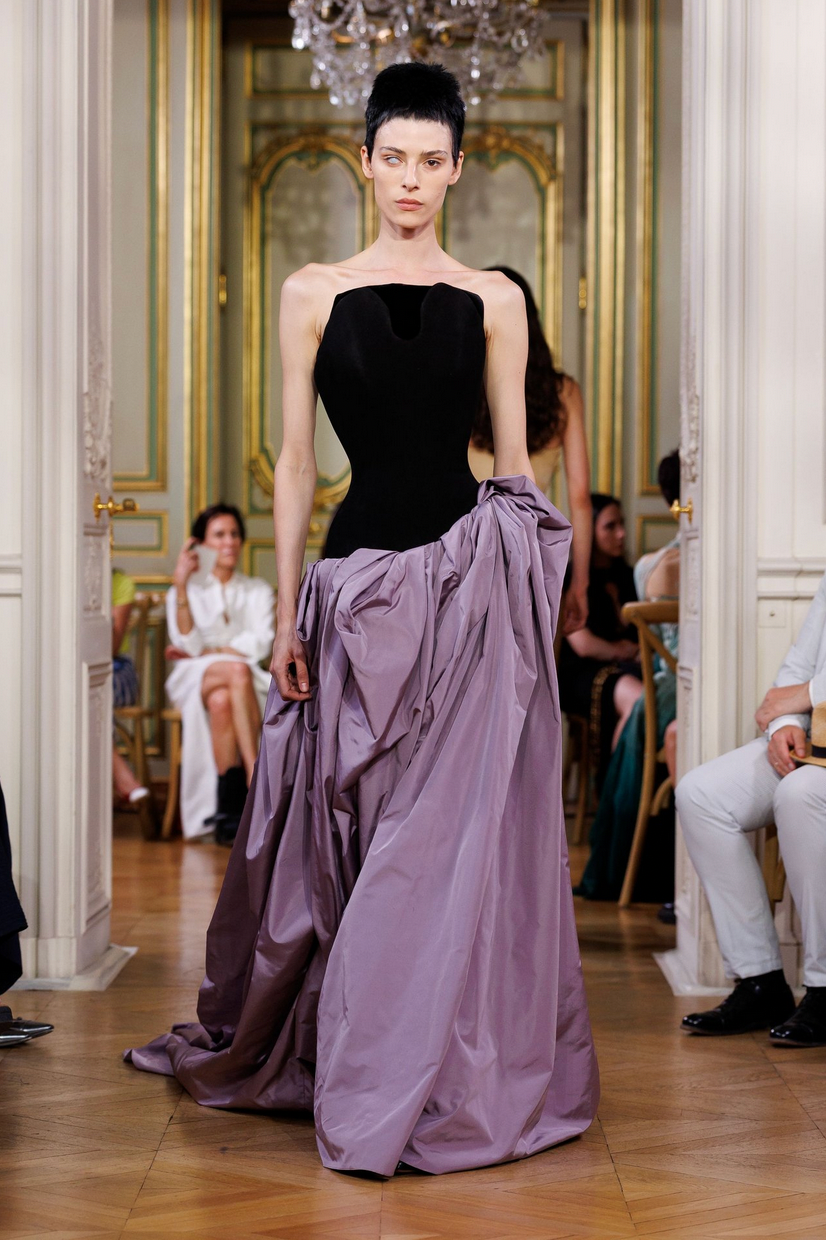
Michael Stewart's Paris debut turned Ireland's ancient standing stones into couture, and proved that craft, not novelty, is what earns a room's applause.
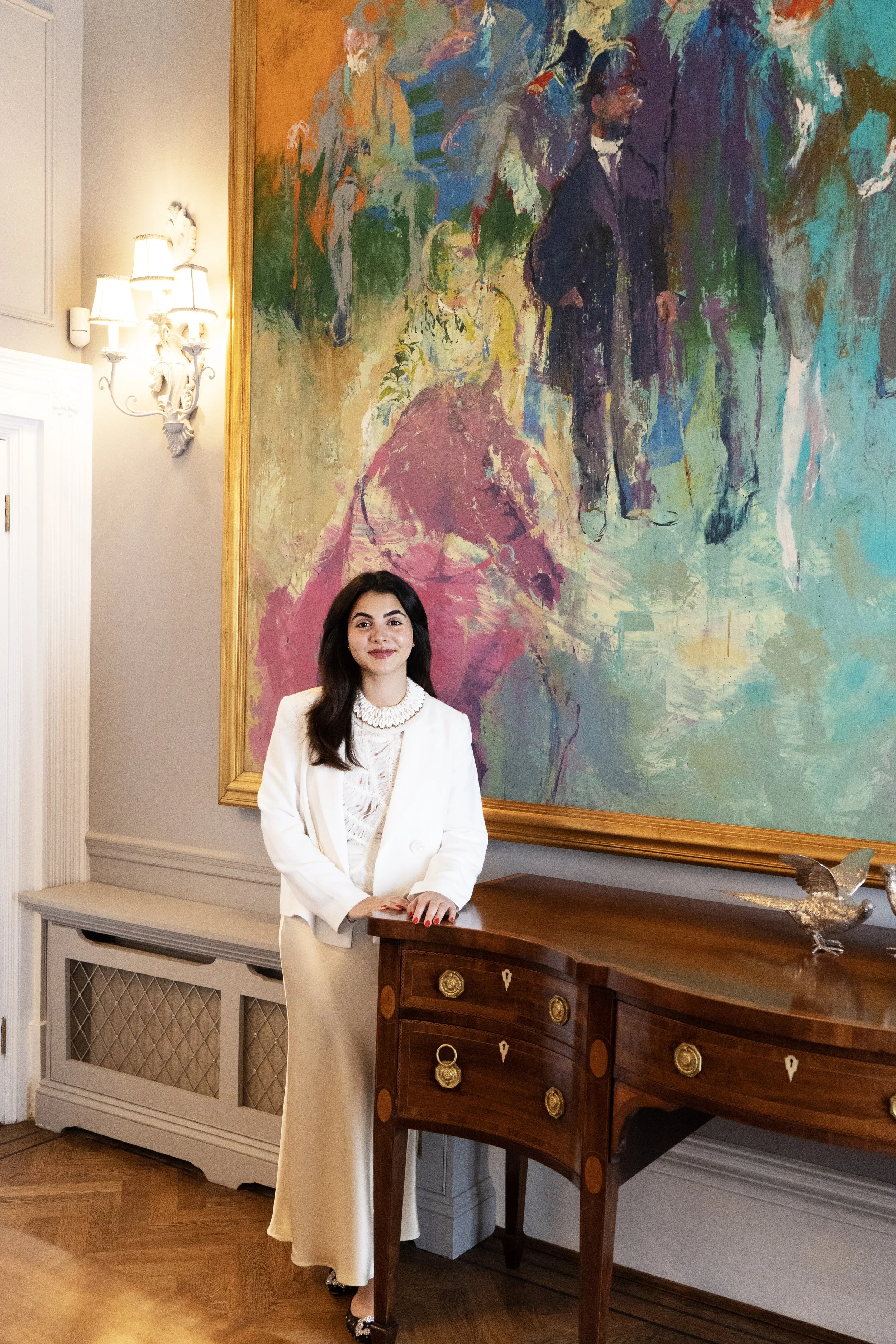
Every so often, a fashion week produces a debut so assured it reshuffles the pecking order before the week is even over. This is precisely what came about on July 6, 2026, when Irish designer Michael Stewart brought his four-year-old label, Standing Ground, to the official Paris Haute Couture calendar for the first time, and by most accounts walked away with the week's biggest story. Anna Wintour sat front row, alongside Tim Blanks, Amanda Harlech and most of the industry's core creative figures. I've had the privilege of calling Michael a friend for close to a year now, and watching that friendship overlap with his debut, watching an idea move from concept to execution to that final presentation, was its own kind of privilege. I felt proud watching my friend succeed. I also cried a little, if I'm honest.
The setting alone signaled ambition. Rather than book a conventional showroom, Stewart staged the show inside the gilded salons of the Irish Embassy in Paris, a formal, old-world backdrop that made for an interesting counterpoint to the primordial, almost archaeological mood of his clothes. Around 150 guests packed in, aggressively fanning themselves against the heatwave that had settled over Paris that week. For a designer showing his first official couture collection, in a week that also included Pierpaolo Piccioli's debut at Balenciaga and Duran Lantink's first outing at Jean Paul Gaultier, that turnout alone was a statement.
To understand why critics reached for words like "monumental," it helps to know where Standing Ground's visual language actually began. The label's name, and pretty much its entire design philosophy, traces back to the standing stones of Ireland: the dolmens and megalithic monuments scattered across County Clare, where Stewart grew up. He talked about visiting them as a child and being struck by how they simply outlasted everything around them, upright for thousands of years, functioning, in his words, as some of the earliest landscape design ever attempted. It's a real reference point, not a marketing line. Neolithic standing stones were humanity's first large-scale experiments in sculptural form, where mass, verticality, and posture used to mark a place and hold a presence in it. Stewart has spent his career translating that grammar onto the body, treating a garment the way a megalith-builder might have treated a block of stone, giving it stance and weight and gravity rather than ornamentation.
That sculptural instinct shows up in how he works too. Stewart doesn't design from mood boards or sketches of other people's garments. He drapes cloth directly onto a mannequin and builds patterns by hand, closer to how a sculptor works clay before it gets cast. He's spoken about shaping accessories in clay before finishing them in fiberglass and resin, and about looking to the "stance" of ancient Greek and Egyptian figures for how his garments should hold a body in space. It's a lineage that runs from Cycladic idols and kouroi through the draped marble women of classical antiquity, artists who spent centuries figuring out the exact problem Stewart returns to every season: how cloth falls, gathers, and reveals the figure underneath.
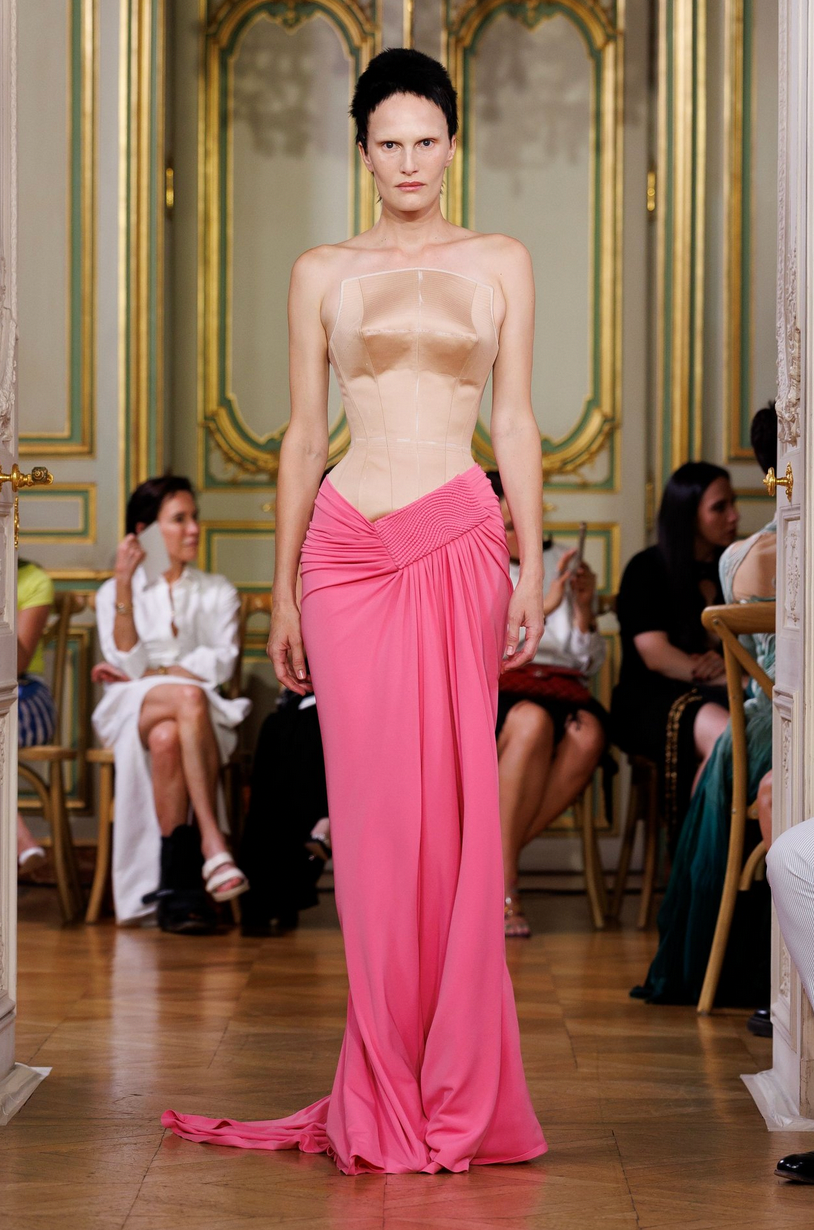
Those ideas were on display at the Irish Embassy. The show opened in somber grey, a bias-cut skirt paired with a sharply structured jacket whose raised beadwork only revealed itself up close, before moving through a run of ultra-structured corset tops matched with draped, sculpted skirts and elongated mermaid gowns. Color arrived unapologetically. Bubblegum-pink trains, a mandarin-orange taffeta skirt, a lemon-lime strapless gown covered in his signature beading. But the real subject of the collection was form, bodies molded, suspended, and framed the way a figure is framed in stone. A handful of models wore a single opaque white contact lens in one eye, a small, unsettling touch that fit the collection's larger preoccupation: garments that feel like they could belong to the past, the present, and some unbuilt future all at once.
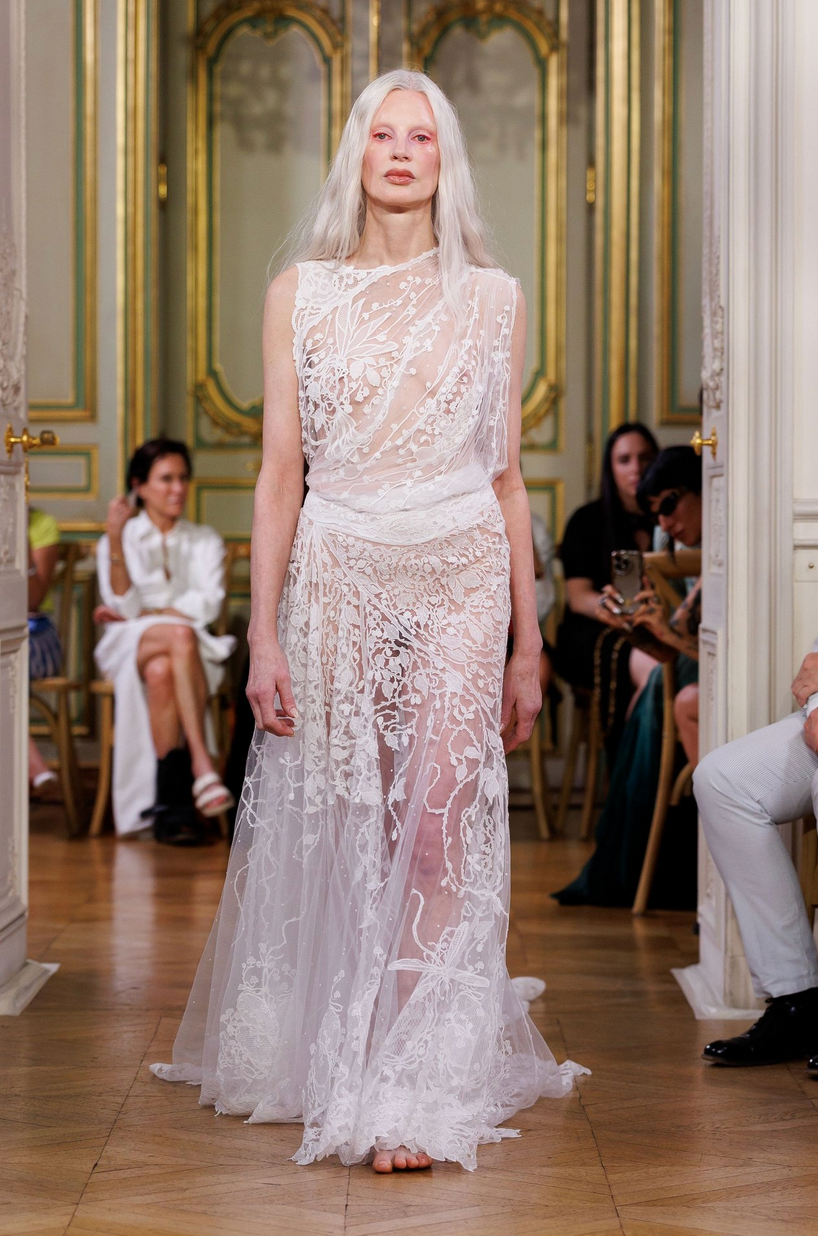
That interest in craft as a form of permanence found its fullest expression in the closing look. Kristen McMenamy, walking barefoot, closed the show in a sheer wedding gown of handmade Irish Carrickmacross lace, a motif Stewart drew himself before sending it to Ireland to be realized by 26 artisans ranging in age from 22 to 95. The dress took roughly 4,000 hours to make, a number Stewart kept repeating backstage, less as a boast than as the whole point of the exercise. Like the standing stones he grew up visiting, it was built to hold up as a record of labor and time, not just a seasonal statement.
The reviews that followed were close to rapturous, with several critics calling it the strongest collection of couture week and reaching for comparisons to Azzedine Alaïa, Iris van Herpen, and Schiaparelli. What seemed to land hardest, though, was Stewart's refusal to chase novelty for its own sake, his insistence on going deeper into a single vocabulary rather than reinventing himself every season for applause. That's an old idea, older than fashion itself: sculptors have returned to the same forms and materials for millennia, refining rather than discarding. Four years after founding the label, and two years after winning the LVMH Prize's Savoir-Faire award, Michael used his Paris debut to make a case for slowness and craft on the biggest stage there is. And for that, a standing ovation to Standing Ground. Michael, may you keep rising.