A New Kind of Perfume House Is Emerging— Made for City Girls With Cult Taste
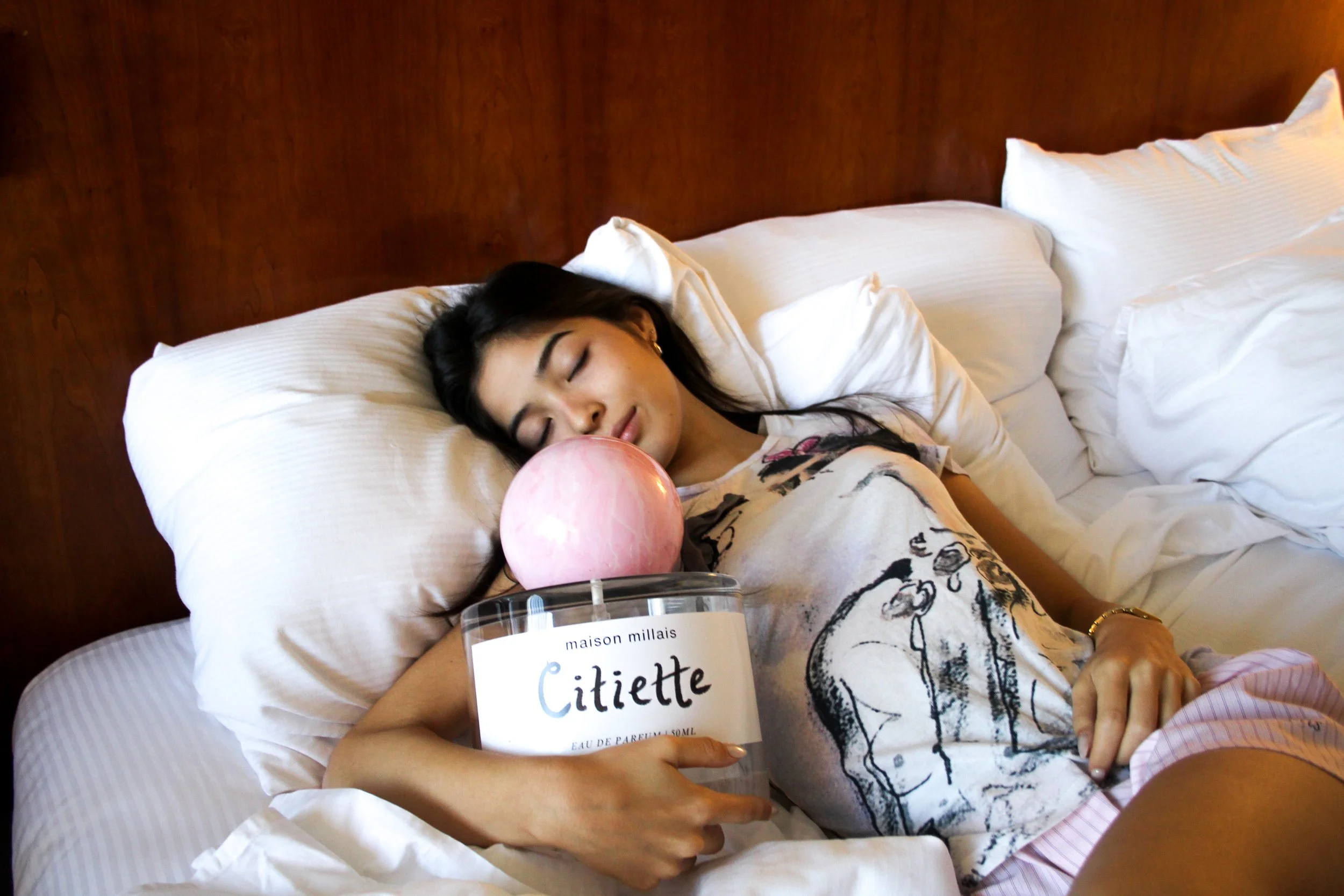
The 2026 It-Girl doesn’t need fifty bottles (though she may own them) because her vanity reads less like retail and more like curation. She doesn’t smell like “rose.” She smells like “clean sheets at the end of August” or “crushed tomato leaf after rain in the East Village.” Like a memory you can’t quite place but don’t want to forget.
A New Kind of Perfume House Is Emerging— Made for City Girls With Cult Taste
For years, fragrance has relied on mystique without transparency, glamour without ecology, and branding without narrative depth. Sustainability has too often functioned as a footnote, while storytelling has been flattened into trend cycles and #PerfumeTok virality. And as consumers quietly evolve from searching for a single “signature scent” to building “scent wardrobes”— fragrances for mood, season, ritual, and becoming— many houses are still selling fantasy in minimalist beige.
But 2026 smells different.
Fragrance has become the final frontier of personal branding. In an era of algorithmic sameness, scent is the one medium that resists replication. It can’t be screenshotted, filtered, or reverse-engineered at a glance. The new aspiration isn’t abundance— it’s precision in interest and self-possession. A fragrance that functions acts as a human watermark. There’s something especially romantic in the idea of leaving behind a sweater or a set of cool sheets and being recognized not by your absence, but by the trace you’ve left in it. The 2026 It-Girl doesn’t need fifty bottles (though she may own them) because her vanity reads less like retail and more like curation. She doesn’t smell like “rose.” She smells like “clean sheets at the end of August” or “crushed tomato leaf after rain in the East Village.” Like a memory you can’t quite place but don’t want to forget.
The brands rising now aren’t selling status. They’re selling sensibility. Narrative intimacy. Cultural literacy. Less inherited mythology, more authored world-building. Consumers don’t just want to smell good— they want to feel considered.
This is precisely where Maison Millais sits.
Based between New York and Paris, the independent house has become a quiet fixture among a certain internet intelligentsia. You’ve likely seen the bottles— clean, architectural, self-assured— circulating across Pinterest boards and vanities belonging to Eva Meloche, Amanda Sujin, and Phoebe Tonkin. The names linger longer than the marketing copy: Funny Little Things Whispered at Very Important Dinner Parties. Nothing Short of Extraordinary. Gods Wait to Delight in You. They read less like products and more like lines from a novel you want to take home and annotate, while the brand’s “Citiette” muse felt specific rather than aspirational: urban, observant, romantic without being saccharine.
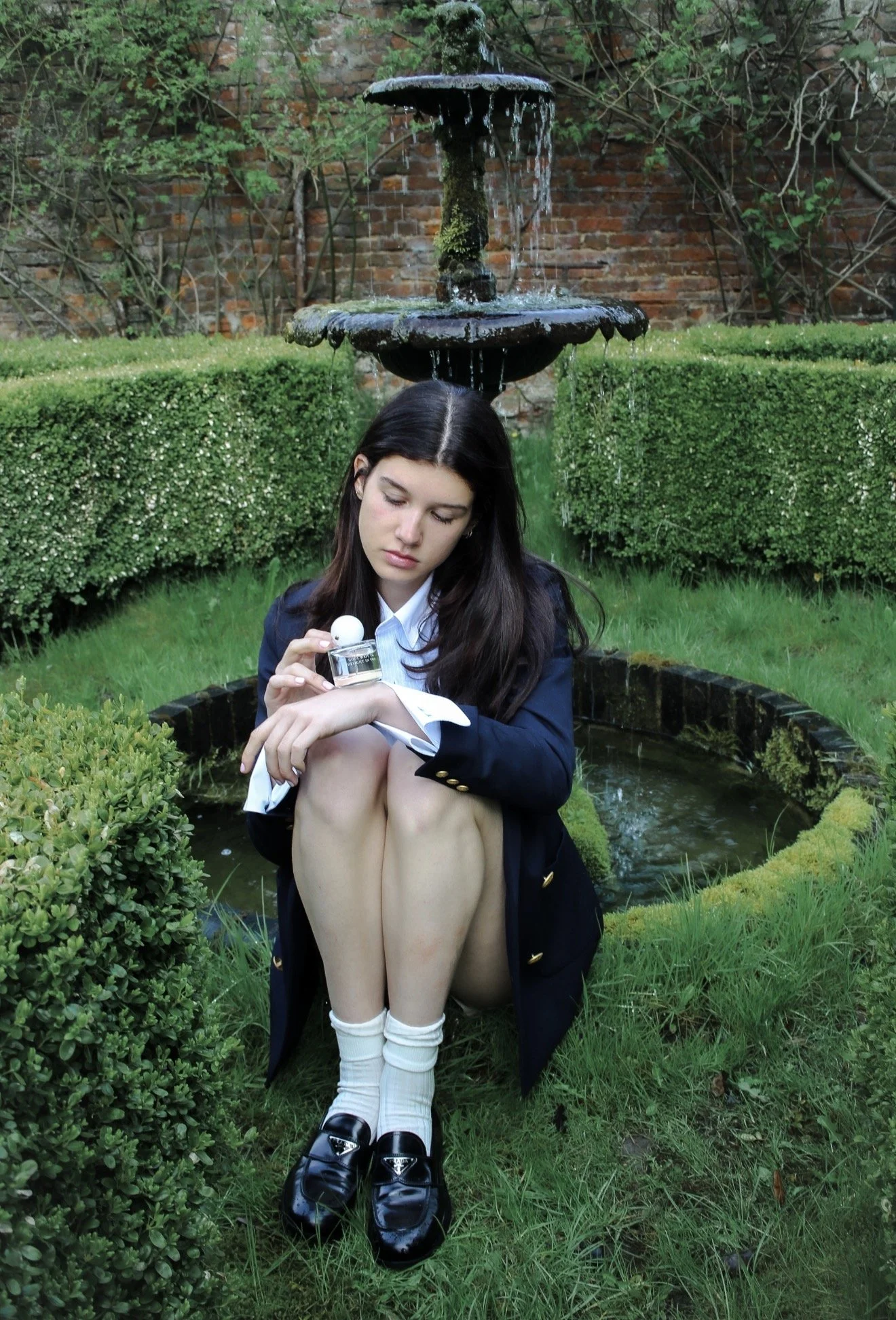
Underneath the design fluency, however, was something more structural. Maison Millais positioned sustainability and clean formulation not as a headline, but as a baseline. Vegan. Phthalate-free. Animal-test-free. An “of course,” rather than a campaign.
Now, the house is entering what founder Haera Millais describes as a “growing up” moment— though not in the conventional sense. It is less evolution than return. Before Maison Millais was a brand, it was an impulse: composing fragrances and sending them quietly to friends and mentors around the world— intimate gestures that felt less transactional and more like correspondence.
What’s shifting isn’t the heart of the house, but its clarity. A repositioning toward a more exacting, luxe alignment. A deeper investment in material integrity. A sharper articulation of what a contemporary perfume house can be when it refuses inherited codes of exclusivity while still honoring craftsmanship. And Ms. Millais speaks with the same measured intentionality that defines her formulas, reflecting on restructuring, collaboration, sustainability, and what it means to build a maison that is porous rather than mythologized— a house that houses the city, and the people moving through it:
You’ve described this moment as a “growing up.” What did the earlier version of Maison Millais believe that the current version no longer does?
I would actually say this moment is like going back to the very beginning of the brand. I often think of change and growth being a horseshoe— you begin to embark on something, and undergo all sorts of trials and tribulations, and come back to the same place, but a little different, a little altered, and with greater surety. The consensus from the beginning was to do things differently, and create perfumes and a space that were thoughtful and intelligent as much as the people who will be wearing them. I think our customers have also grown up over the past two and a half years, and I want to meet them where they are. Now, I have the clarity and desire to move forward with the Maison Millais point of view without restraint.
With a repositioning toward a more luxe alignment and a significant price shift, how do you define luxury for yourself? Is it exclusivity, craftsmanship, scarcity— or something else entirely?
Perhaps we traditionally perceive luxury as an effort to accumulate exclusivity in both its worldbuilding and operations. However, there is also a serious compromise in ethics in that pursuit. I wanted to ask myself: from what else— besides sole aspirationality and scarcity— can beauty and pleasure be derived? To that, I believe true luxury is actually to plunge into it all, to conceive and meet life as flux. Aesthetics should be in relation to life itself, and the world you build and the products you bring into the world should accompany the lives of those who engage with your brand. Craftsmanship, a word we like to wield often, is directly linked to labour— physical and emotional, human labour.
So if I’m talking about luxury, I’m also talking about the conditions that allow work to be done with care. Perhaps this is all abstract, but in my decision-making, I hold myself to always think beyond, to be thoughtful in how I conduct myself, and those who work with me. This will always be directly reflected in how your brand comes out and the impressions people receive from it. So for me, luxury is not only the object but the whole ecology around it.
A price increase inevitably reshapes accessibility. How do you reconcile that shift with your emphasis on collaboration and shared cultural narrative?
The decision to restructure pricing came from the latter desire— to increase collaboration and bring about more relationships between perfumers, farmers, ateliers, writers, image-makers, and the people who wear the work. Each fragrance is also composed with more delicate and natural ingredients, which simply cost a lot more. When increasing natural materials and working with more people, there is an inevitable price increase. It’s not very romantic, but the decision was an economic reality, as we are wholly independent. But I don’t see the price shift as a move away from shared narrative, but rather, what makes it possible.
Collaboration costs money when you want it to be real and ethical: you have to pay people properly, you have to give time, and you have to produce with care rather than speed. And I hope to allocate some room to put forward both playful and meaningful initiatives that people can be part of. The shared cultural narrative, to me, is that people can participate in it and recognize themselves in the world we’re building. The price increase will also enable us to connect with more retailers with a broader reach, so hopefully it will be an opportunity to offer Maison Millais to more people geographically and in terms of discovery. In the end, my effort is to make the brand more sustainable so it can last, and so the collaborations can deepen rather than remain occasional gestures.
What does creative maturity look like to you right now? Is it restraint? Fewer launches? Deeper storytelling? Greater material integrity?
I suppose all of it. Thank you for articulating them for me! I don’t exactly make any effort to be more mature in a creative sense— creativity is intuition, something you inhabit, not wield. So, regarding launch timing and storytelling, I just go back to my own impressions and observations of the world. Anything beyond this, I know very immediately, would feel contrived, and, frankly, quite boring.
Material integrity is probably my biggest concern and the most fruitful of my efforts at the moment, as I have been running around various farms and ateliers in North and South France. I am very happy to say that the creation of Maison Millais perfumes now directly benefits the artisans involved. The maturity is understanding that the narrative doesn’t need to be invented; it’s already embedded in the materials, the relationships, and the thought that it takes to bring something into the world.
Traditional perfume houses often root themselves in geography and heritage. If Maison Millais isn’t anchored to one physical place, what anchors it?
Perfumery is inherently transcultural. No culture is monolithic, and the world we find ourselves in is shaped by mixture; we are entangled and relational. I want to pose the question and to consider a fragrance house that reflects that condition. I think it’s time for a sensibility that is attuned to flux, to in-between states, to the intimacy of encounter— and to the people I’ve surrounded myself with, who have always led quite international lives. If there’s a geography, it’s the geography of rapport and relationships.
You’ve described the brand as editorial and art-adjacent. What makes a fragrance feel editorial rather than purely commercial?
Every day there are a lot of decisions to be made, and a lot of that is in the realm of deciding between furthering a point of view versus furthering what is simply legible. Of course, the effort is always to find a reasonable balance, but because of its rather organic construction, Maison Millais doesn’t exactly begin from a pure commercial ethos but from a sensibility, and then the rest has to orbit that. I actually think beginning from the question of “will it sell?” is much harder, as it can limit your thinking and understanding.
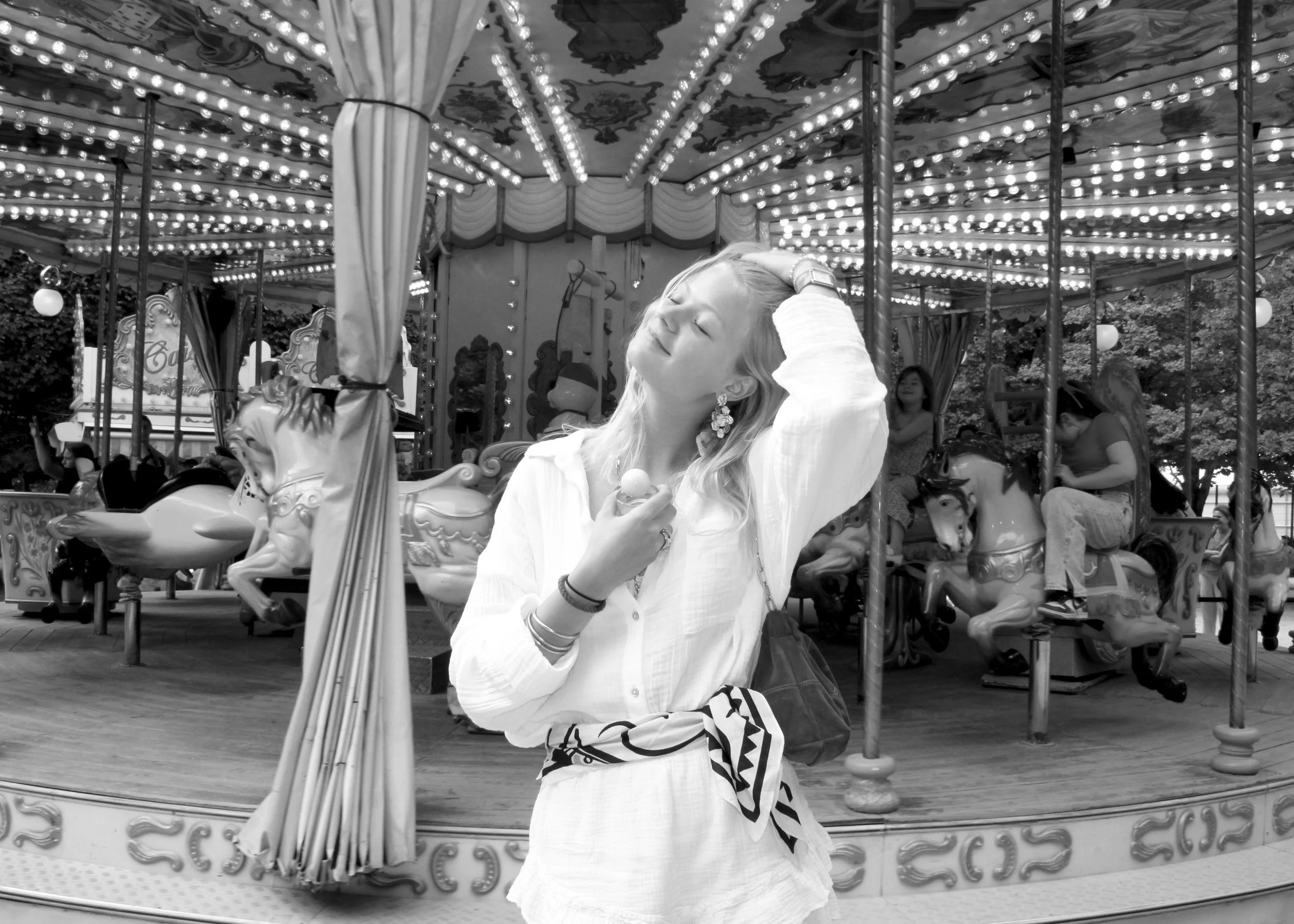
And I suppose I can’t not speak about the emphasis on visuality. Because I think “editorial” also means there’s a world around the scent, a texture of life that the brand is in conversation with. I like to do a lot of the photography myself, and often in spontaneous moments when I’m with friends. There’s a funny episode where my friend Sixtine and I were shooting at the carousel at the Tuileries Garden, and we lost track of how many rounds we’d gone on, and the ticket checker jumped on the carousel and started yelling at us. But because the ride was going on, neither party could get off. Those were very long four minutes...! Perhaps (and I hope) those stories resonate in a more intimate register. When composing a scent, what comes first: a memory, a person, a mood, an image, or a broader cultural observation?
Usually, a constellation of images. Or sometimes it’s a painting or a photograph I meet at an exhibition. And it’s not always nostalgia in the traditional sense; it’s more like I begin with a moment in time, a moment in becoming. And sometimes the broader cultural observation is there too, but indirectly: it’s embedded in what I’m drawn to, what feels exhausted, what feels newly possible. The formula becomes a way of translating that constellation into something you can spritz and carry.
If the bottle and branding were removed, what would make a Maison Millais fragrance identifiable?
I love this question. We are a perfume house, after all. Millais fragrances generally lean fresh, “dry,” and sophisticated— not sticky or heavy. They’re complex and diffused, where individual accords aren’t photorealistically distinguishable; instead, the experience should feel like a whirlwind of complexity. I also think there’s a restraint to them. They’re intelligent fragrances: thoughtful, elegant, and held back in a way that leaves room for the wearer.
Sustainability has become a baseline expectation in beauty. What does it mean operationally for Maison Millais— beyond philosophy?
I think this is important to share clearly, and I’d like to, so thank you for asking. Operationally, it starts with structuring the business so we don’t create unnecessary transport touch points as we grow. I think a lot about how to expand globally without multiplying shipments, re-routing, and repeated handling. On the materials side, while all the aesthetic elements I compose myself, I also work with a sustainability consultant who advises on packaging, component choices, and new types of materiality we could work with. He is always suggesting new ways of doing things, and for that I am endlessly grateful.
Working with Credo Beauty has also been quite lovely, because we’re in constant conversation about what may be the right direction and approach we can take. That level of expertise and exactitude is imperative when you’re producing material products. We’re actually working on a candle project for later this year, and we’re working with a perfumer versed in natural perfumery, which I’m very excited about. It’s a great pleasure to work with someone with this sort of intensity— beauty, but also ethics.
If Maison Millais were to disappear tomorrow, what would you hope remains— in memory, in impact, or in culture?
Young people full of effort and energy.