When Fashion Becomes Art: on Mohammed Ashi
Hand-painted gradations soften architectural volumes. Wooden bustiers, sculpted shells, and rigid bodices serve as load-bearing elements, distributing weight much as structural frameworks do in architecture. Fabric is treated not as surface but as substance, layered, tensioned, and sculpted into form. The couturier here operates simultaneously as an engineer, an architect, and a sculptor. Image: Courtesy of Ashi Studio
When Fashion Becomes Art: on Mohammed Ashi
Placed in a museum or institutional context, Mohammed Ashi's silhouettes declare themselves as sculptural objects. Yet the moment these garments are worn, their meaning appears to shift, from sculpture to couture, artifact to garment. The object itself remains unchanged. What shifts is context. Through a Duchampian lens, we are led to believe that classification is determined not by construction, but by placement.
Ashi resists this division altogether. His couture retains the gravity of sculpture wherever it exists. Ashi, in his own words, declares, "We use the word sculpted a lot at [Ashi Studio] as we are quite architectural in our style and shapes." His garments are objects that neither rely on ornamentation nor reach for theatrical excess. Instead, Ashi's success comes from technical precision, material intelligence, and conceptual restraint. In doing so, Ashi's work dissolves long-standing boundaries between fashion, sculpture, architecture, and art.
Founded in Beirut in 2007 and now based in Paris, Ashi Studio has become one of the leading houses that approach couture not as adornment but as an extension of artistic expression. His devotion to volume, silhouette, and conceptual rigor has positioned the studio among the few expanding couture houses into the realm of objecthood.
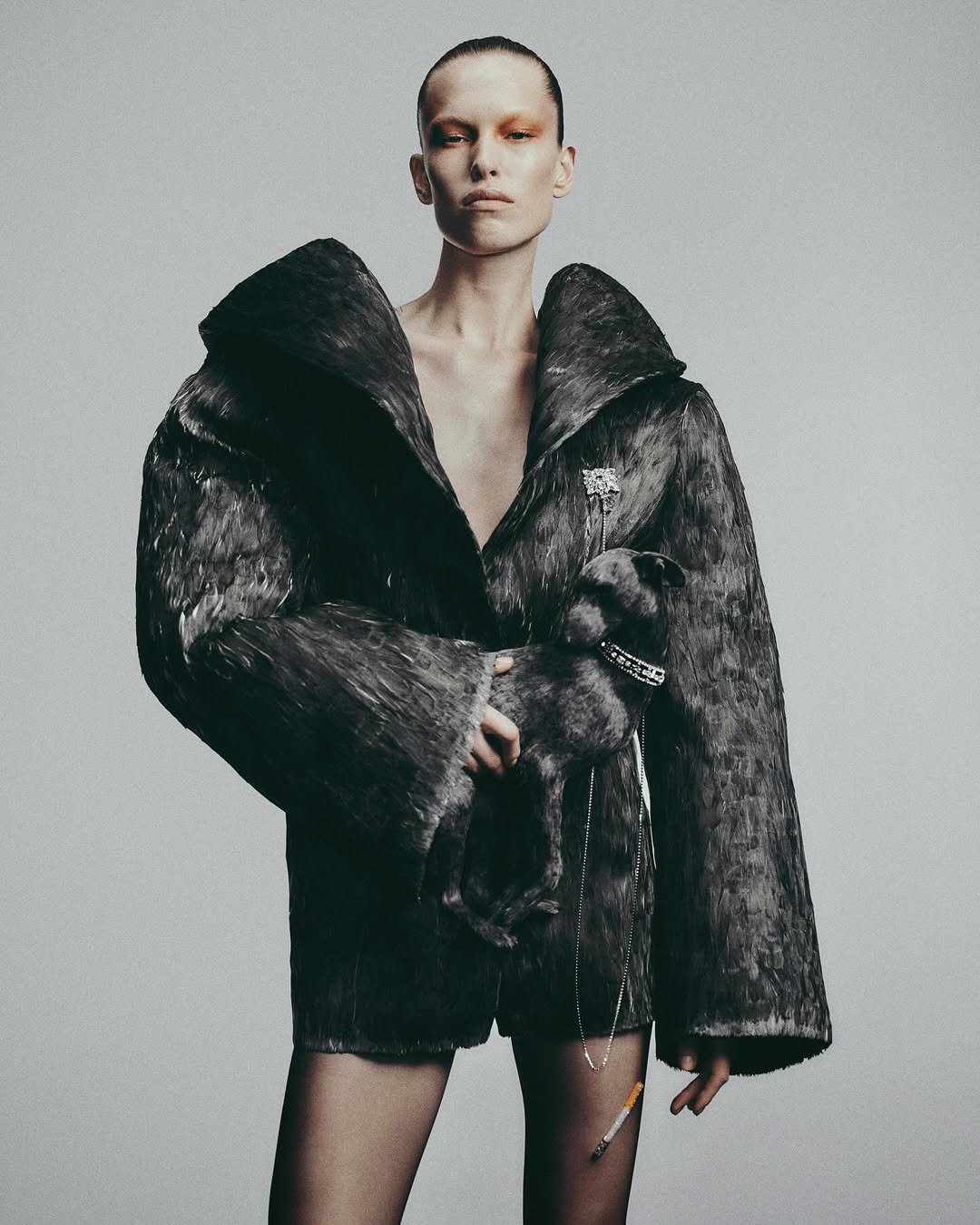
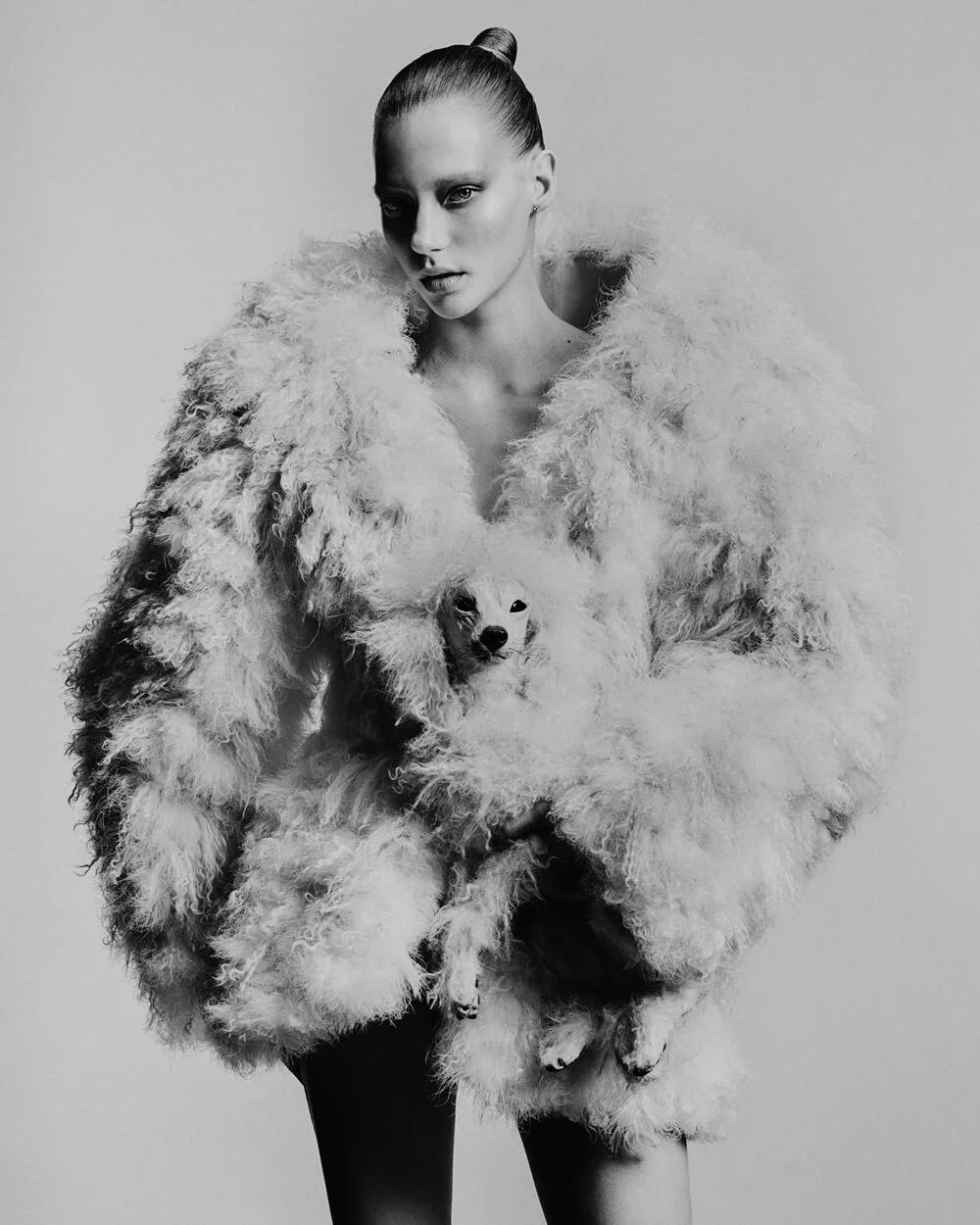
This sculptural logic is most poignantly articulated in Ashi's Velvet Underground collection. Sculptural canines enter directly into the language of the garment, extending his commitment to couture as a contemplative practice rather than a site of spectacle. An ivory shearling coat envelops the wearer's silhouette entirely, cocooning the torso in a dense mass of texture that behaves more like spatial volume than clothing. The coat does not frame the body, it dares to absorb it.
In a couture landscape that privileges recognisability and red-carpet virality, this approach is almost radical. Ashi allows the garment to eclipse the wearer, producing a moment of visual stillness in which the viewer is asked to contend with form itself rather than personality, movement, or performance. Embedded within this mass is a sculpted poodle, emerging from the same wool. Rather than functioning as an ornament, the canine is integrated into the surface. The garment becomes an inhabited relief. The body is no longer the subject; it is the support or base onto which the sculptural garment comes to life.
Courtesy of Ashi Studio
This is where Ashi's work differs from the spectacle-driven logic of contemporary couture. In his practice, sculptural figuration shifts the garment into the register of the autonomous object, closer to constructed form than to a styled look. These garments would take on greater meaning in an institutional display, in the conditions of a gallery rather than the transient and fleeting nature of the runway. They articulate what resides at the heart of Ashi Studio's practice: couture as spatial, ever questioning and carefully considered, operating at the intersection of architecture, cultural lineage, and sculpture.
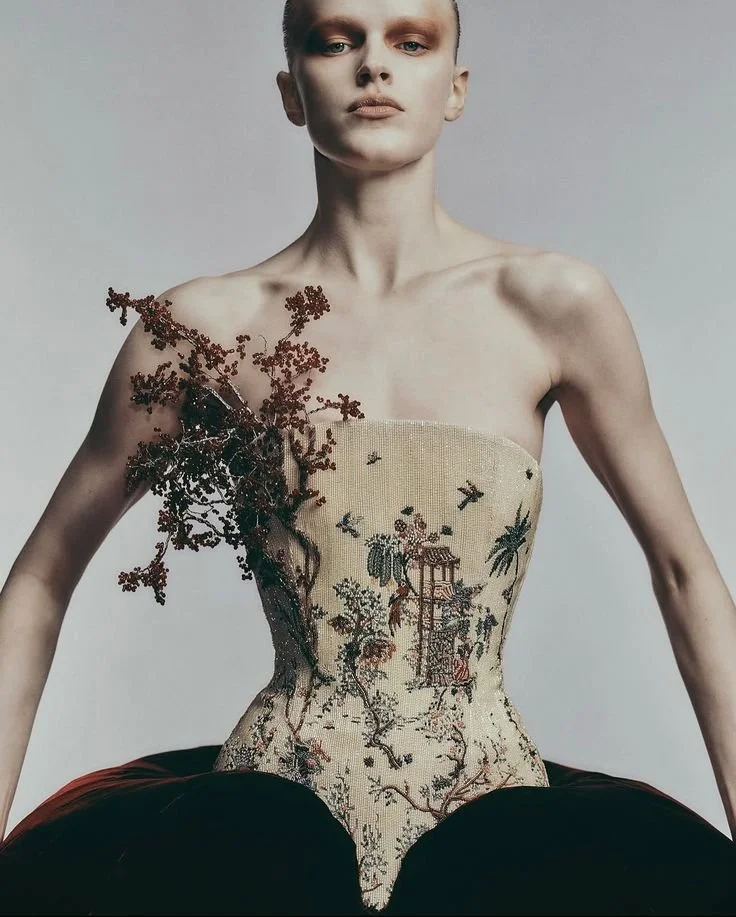
In another sculpted silhouette, Ashi draws explicitly from art history. A beige corset intricately embroidered draws on the visual vocabulary and iconography of 18th-century chinoiserie. Imagery of pagodas, floral motifs, and pastoral scenes, recalling that of the lacquer panels from Qing-dynasty China and domestic interiors where textiles once functioned as storytelling screens and hangings, designed to structure space as much as remain an ornamental device. At the side of the corset, a branch emerges, interrupting the surface. This sculptural extension pushes the garment into the realm of a sculptural object. The branch is not appliquéd but constructed as an extension of the textile itself, implying a narrative in which the surface generates its own depth.
In Ashi's couture, the body is repositioned. Rather than functioning as the primary site of expression, it becomes a pedestal or base. His garments do not aim to flatter or dramatise the figure in a traditional sense. They assert themselves as dominant forms, existing first as objects and only secondarily as clothing.
This situates Ashi within a lineage of designers who seek to obscure the body and challenge how we define couture. Cristóbal Balenciaga's sculptural cones and Charles James' Taxi and Clover Dresses questioned whether fashion required the body as the primary focus to communicate meaning. In Ashi's work, the garment resists immediacy and consumption, demanding slow looking and analysis of his garments as forms of artistic expression. In this collapse of couture and sculpture, Ashi produces works that deliberately sit at the cusp of both disciplines.
Courtesy of Ashi Studio
Hand-painted gradations soften architectural volumes. Wooden bustiers, sculpted shells, and rigid bodices serve as load-bearing elements, distributing weight much as structural frameworks do in architecture. Fabric is treated not as surface but as substance, layered, tensioned, and sculpted into form. The couturier here operates simultaneously as an engineer, an architect, and a sculptor.
In an industry dominated by mass commercialisation, Ashi's work proposes an alternative approach. His garments resist the runway's conformity to speed and spectacle. While the studio does indeed circulate within fashion's seasonal rhythms, they are fundamentally unsuited to ephemerality. These works demand contemplation.This reframes couture as a wearable art form rather than a fleeting, commercial object. The garments possess permanence on conceptual, material, and cultural levels. Ashi aligns couture with preservation and custodianship, positioning his work within a longer art-historical canon rather than one that follows today's trends.
In a fashion playground overloaded with noise and mass commercialisation, Ashi's garments endure. They do not chase attention or virality. Instead, they ask the viewer to introspect, to mediate, and to consider fashion not simply as image or industry, but as enduring, architectural, and an extension of artistic expression.