From Storybook to Runway: The Alchemy of Play
Chiaroscuro is an Italian art term describing the use of strong light and dark contrasts to create dramatic effect in paintings. In life, we create a similar effect when our conscious and unconscious selves intersect. This column explores that interplay through psychology, philosophy, art, and fashion.
From Storybook to Runway: The Alchemy of Play
Art and fashion have always been inseparable. While some argue that the extreme marketing of fashion as art has deracinated the latter to the point of redundancy—taking away its essence as a means of deeper cultural commentary and introspection and converting it into a vacuous tool for commerce—it’s hard to negate the fact that designers who are truly devoted to their craft create pieces that can serve as enduring mementoes of their time while also being rather stimulating emotional vessels for the viewer as much as for the creator.
A subtle, almost teasing skill to evoke emotion is what contributes to an artist’s identity. His sincerity then lies in inviting us to interpret his world as we please, placing us within the boundaries of his thought but not restricting us to it. It reveals something to us just when we need it; the confusion and longing present us with an answer in the most unpredictable manner, much like the architecture of creation itself.
Kid-like Wonder on the Runway
Colm Dillane understands the delicacy of this oxymoronic notion and dives into it with integrity through his ever-amusing world of KidSuper. The brand finds its voice in its philosophy of living in the moment—a childlike spirit of converging creativity with indelible joy and wonder.
The ethos of the brand is to blend art and fashion, rooted in unapologetic self-expression, and his freedom to do so lies in his ability to engage in artful collaborations.
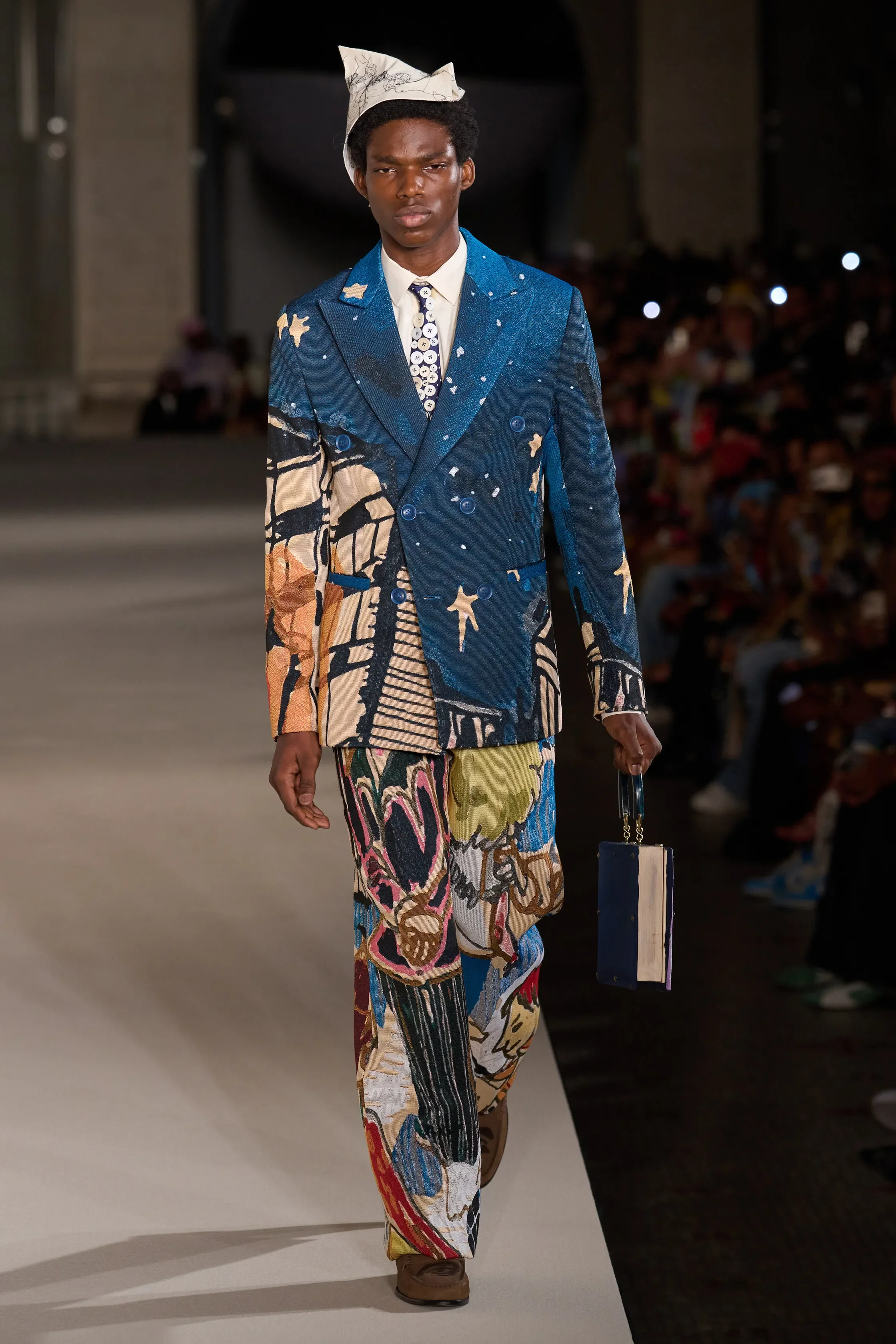
His shows exude theatrical extravagance, pulling the viewer into a trance, leaving him no choice but to confront his lost childlike sense of awe. The recent SS26 collection showcased in Paris further reinforces this fact. Based on a children's story written by the founder himself, The Boy Who Jumped the Moon, models emerged from a life-sized storybook, blurring the lines between fantasy and reality.
A thought-provoking idea, simply written with metaphorical significance. The process of creation is evolutionary in the sense that one might start with a different goal and end up with something extraordinarily better. The process undeniably begins with a dream true to your inner child, taking shape through collective effort and an unwavering faith in your vision.
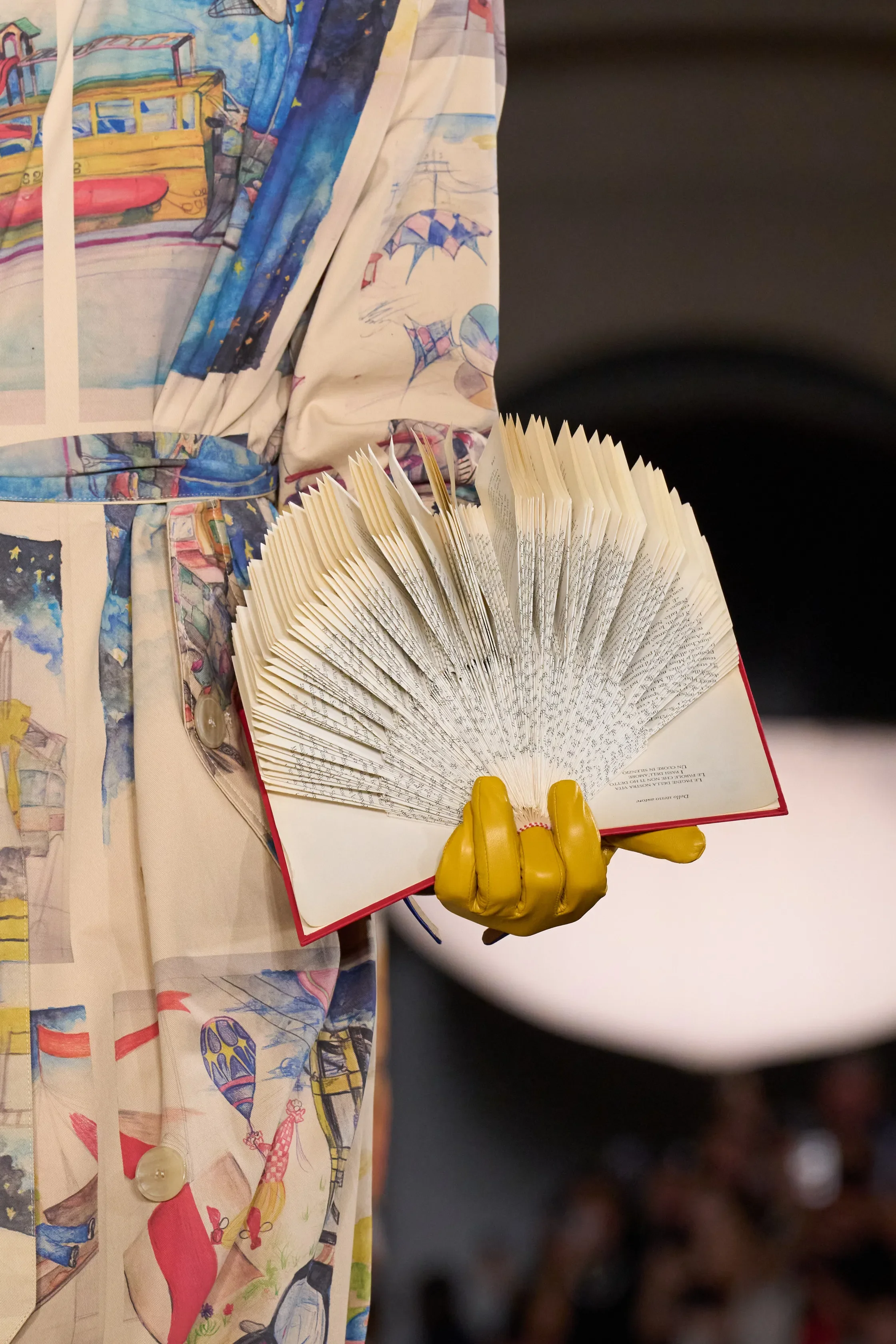
The tactile experience of the set transports viewers back to childhood, with the show narrated by TV host Craig Ferguson, each look corresponding to an extract from Colm’s book. The colour story mirrors the whimsical narrative, blending seamlessly with Colm’s illustrations.
The models create a smooth transition between fashion extravagance and playful dreaminess through ludic detailing layered onto sophisticated, traditional silhouettes—cursive writing, paint splatters, hand-drawn illustrations on canvas-like materials, innovative knitwear, patent leather, and relaxed tailored suits. Quirky elements like the ruffled dress, canvas-inspired overalls, and geometric-shaped tops reinforce the idea of an artist’s pursuit and the invaluable role of play.
The accessories become the focal point, emphasising the allegorical character of the show: a bag shaped like an open book, illustrated headgear, a crown-shaped chino, an exaggerated hand-shaped scarf, and belts with vividly coloured metal characters, to name a few. The frivolity never feels sporadic; instead, it creates intentional thoughtfulness meant to layer without becoming visually or conceptually overpowering—echoing an artist’s atelier.
Play, Psychology, and Philosophy
Dillane’s work as a creative director stands as one of the purest representations of the idea that “the artist is the child who survived.” This phenomenon, where childlike wonder fuels creativity, has been extensively explored by psychologists like Jung and Winnicott, giving us a clearer window into the creative functioning and mindset of people like Colm.
Carl Jung describes this inner child of imagination and constant play in his archetype Puer Aeternus, the source of inspirations and visions that leave us with a sense of awe and implicit belonging to another creative’s work.

Carl Jung, Bettmann/Getty Images
According to Winnicott, creativity and appreciation for art are manifestations of adult play, which bridge the gap between our internal and external worlds. He believed that play was the means through which an individual could express their true self, extending into adulthood as a cultural experience.
To let your inner child guide creative expression, one needs to chase that sense of awe, which opens our perception and dissolves our ego, sparking curiosity. In the space of pure awe, our existence and sense of self start to feel minuscule compared to the vastness of novel possibilities.
We leave you with the question of introspection: What stimulates your inner child, and how can you manifest that sense of wonder in your work and everyday experience?