Slow by Design: Inside John Kim's Philosophy at KIMIAS
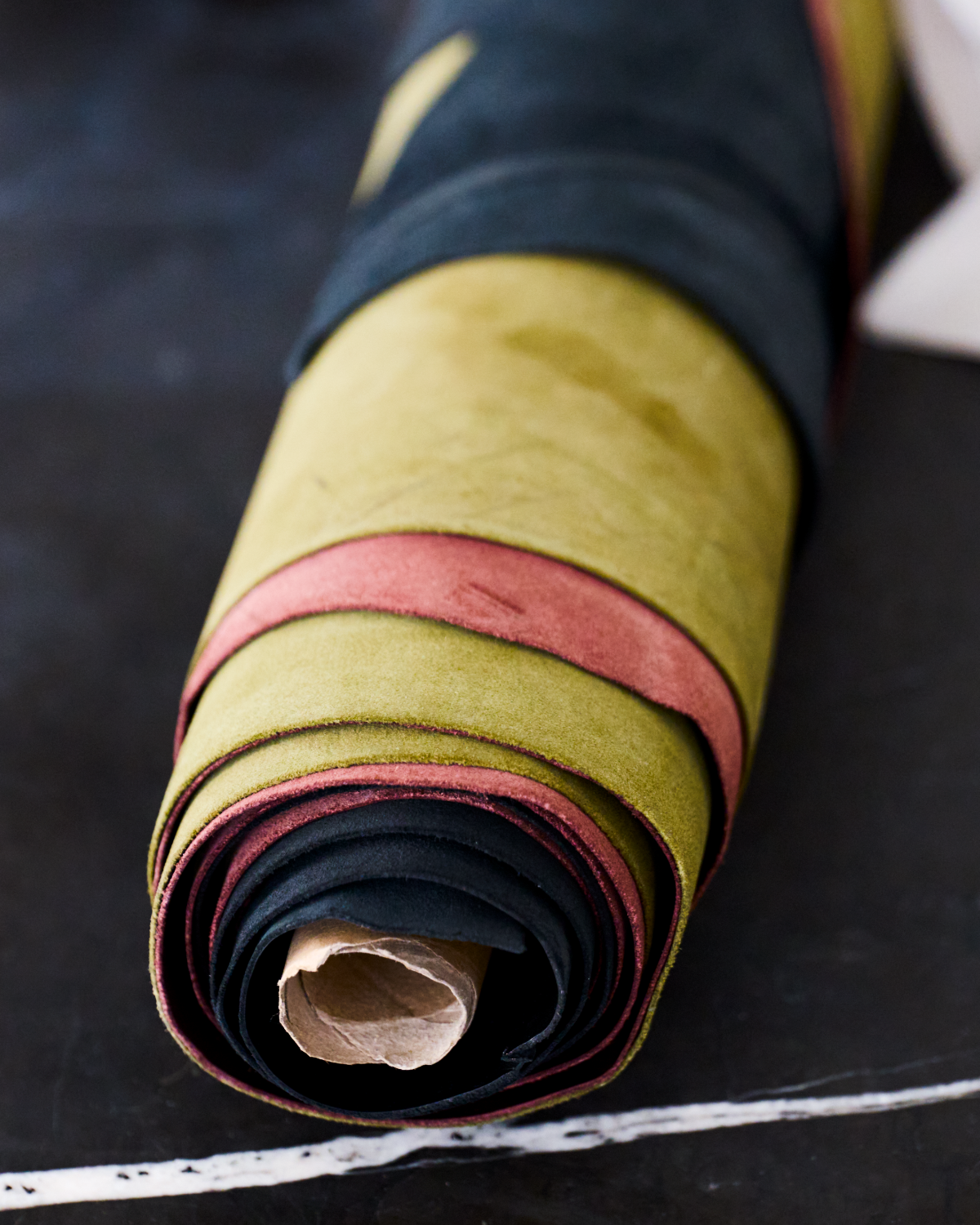
“If I was going to do this leather goods thing, I wanted to do it exactly how I envisioned the brand should be. The curvature was important to represent the human body. The oil wax leather was equally symbolic for me, representing the skin of a fruit and our hospitality ethos. They went straight to the heart of the brand, and to a standard of craft.”
Slow by Design: Inside John Kim's Philosophy at KIMIAS
This brand spent 15 months developing a custom leather for its bags—and somehow that’s only part of the story. For KIMIAS founder and designer John Kim, every piece has to pass what he calls three tests: the eye test, the usability test, and the craft test. That meant chasing down LWG Gold-certified tanneries, getting turned away by major suppliers across Europe and Asia, and eventually going through more than 20 physical prototypes each for the Contour Shoulder and Contour Carryall until the silhouettes felt exactly right.
Before we get into KIMIAS—if you had to introduce yourself not by name or résumé, but by your lived experience and philosophy, what would you say?
I've always been someone who romanticizes life, not in the sense of “candlelight, roses and champagne”, but in the older Greek sense of the word. The idea that living fully is almost a moral act. Chasing beauty, excellence, and the best version of yourself isn’t self-indulgence, but a responsibility. We get one life. Don’t we owe it to ourselves to discover who we really are?
Practically speaking, that philosophy has taken me down a lot of different paths: musician turned engineering student turned philosophy major; construction project manager turned lawyer; lawyer turned restaurateur; and now a restaurateur trying to build a luxury leather goods brand. From the outside, it probably looks like I just can’t make up my mind. From the inside, it’s always been the same question: What do I actually want for myself?
The funny thing is, I’m not impulsive at all. It takes years of simmering before I make a big change because, like most people, I’m terrified to color outside the lines of what I know. But my optimism exceeds my fears, and when I go, I go all in. I’ve learned to give myself permission to grow into things, and to grow out of them, as long as I’m being honest about who I am today.
You have an undoubtedly diverse background. Law, a Michelin restaurant, and now a luxury handbag brand aren't conventionally connected careers. What's the actual discipline or instinct that carried through all three?
I always jokingly say that I’m motivated by existential dread. Trying to find the groove in this universe that actually feels like me. Along the way, I've realized I need two things to stay committed to anything: a deep love for the game (whatever game I’m playing), and people I respect and am accountable to.
That balance has become my compass. Law gave me structure and discipline. Hospitality gave me a platform to exercise my people muscles. KIMIAS has become the place where those lessons can intersect allowing me to bring them to far more people than I ever could before. It asks me to execute, create and serve people all at once. Every chapter has taught me something about the next one, so KIMIAS isn’t a departure from everything that came before; it’s the convergence of it all.
You’re also quite the globe-trotter. What's a specific place you've traveled to that played a role in your decision to break into the fashion industry?
If you’re making me pick one place, it’s undoubtedly Italy. Not necessarily because of its storied leathercraft history, but because it was the first place I felt I had permission to freely express myself with fashion. I moved to Rome at 25 to study international arbitration, yet every day I showed up to school, it somehow felt like a fashion show. I was enamored and excited. Growing up in pre-internet America and spending many summers and winters in Korea, I was used to gym shorts, polo shirts and khakis, or school uniforms.
Italy was a different world, everyone was coming in hot each and every day. And I went a little crazy. I had a thing for subtle floral prints, I experimented with proportions, and I had some mildly outrageous haircuts. When in Rome, right?
The irony is that my fascination with cultures and love for international affairs inadvertently fed my fashion soul, planting the seed of “maybe one day…”. Becoming a lawyer was the first time I had the means to explore that curiosity without compromise. And over a decade later, here we are. Go figure.
KIMIAS is built around the idea that the human body itself is the most beautiful form there is. When did that idea first click for you as something you could actually build a brand around, rather than just something you believed?
People have always been my greatest source of inspiration. It was one of the reasons I was excited to get into the restaurant business after moving to LA from New York during COVID. So when I started KIMIAS, I asked myself a simple question: What do I cherish most in this world?
That became my north star, and the more I sat with that question, the more I realized what kept drawing me back wasn’t any one person, but what we all share: the human experience.
Strip away all societal markers of identity, and the physical human form is symbolic of our innate similarities rather than our differences. I knew I would never get tired of designing around, for, and in awe of it. I think human life itself is a miracle, and KIMIAS is my way of celebrating that.
Beauty is subjective almost by definition—how do you design toward something you believe is actually shared across cultures, rather than just your own taste?
We can point to a million differences among us across taste. But we all share the same silhouette of a body, right?
That’s my way of designing toward something universal. Rather than anchoring KIMIAS in a particular culture, geography, or aesthetic trend, I want to anchor it in the one thing we all share. I figured body-inspired silhouettes might not resonate with everyone, but they’ll resonate with some people everywhere, and that was enough for me.
In an ideal world, culture is something we exchange rather than something that can also divide us. Designing KIMIAS objects in appreciation of the human body feels like a small way of contributing to that.
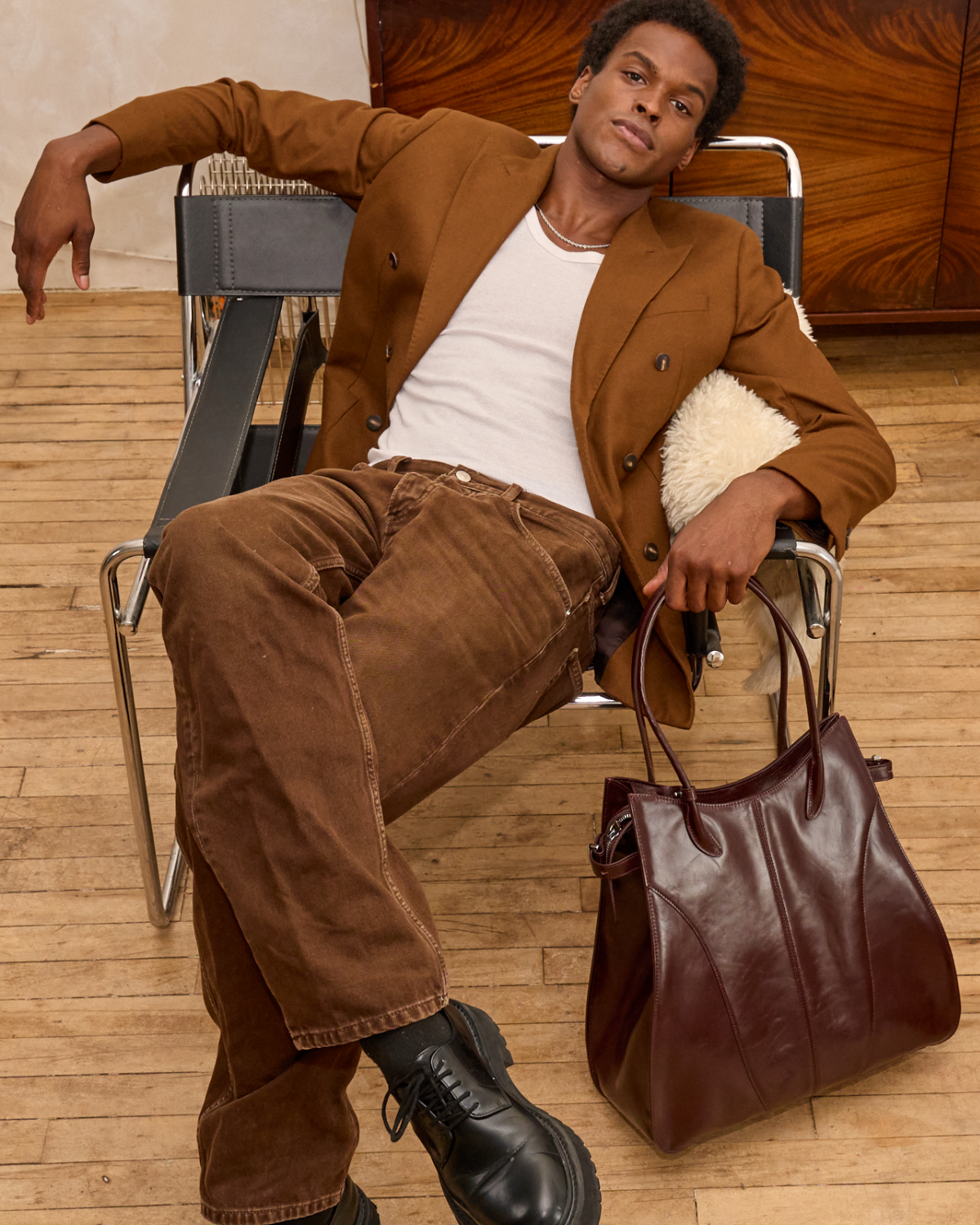
Walk me through the design process for a KIMIAS bag from start to finish.
I start with the bag archetype and purpose. What are we going for? A shoulder bag? A tote? Classic proportions, east-west elongated, or north-south elongated? Then I ask: what's its purpose? Who's going to use it, where, and for what?
Design always comes first. Then I marry it with subtle but function-conscious features, and finally I figure out the craft required to support that marriage. In essence, it has to pass the eye test, the usability test, and finally, the craft test.
Once design and function are decided, I go straight to the arc tool in illustrator. We have to hit those curves! I iterate freely, adjusting the curvature until it feels right, like something I could see mimicking the shadow of a human silhouette. From there, I use that as one edge of the bag and build out one half, constantly mirroring it to create two adjoining symmetrical halves, going almost entirely by feel. I sketch until I feel like the silhouette is right, then move to the details: any body panels, closure mechanisms, the handles or straps, and so on and so forth, trying to enhance the essence of the bag body’s silhouette while keeping functionality in mind.
I’ll spend weeks / months iterating on a design until it feels right. I have probably over 100 designs in sketch form that I’m not completely happy with. And I went through over 20 physical prototypes of each of the Contour Shoulder and Contour Carryall to make sure the silhouette came exactly as intended. I needed the feeling to be right. You can’t logic someone into feeling something. That’s coming from a lawyer.
You spent fifteen months developing your custom Oleó leather with an LWG Gold-certified tannery. What was missing from the leathers that already existed that made you unwilling to settle?
To clarify, I spent 15 months both searching for the right leather, developing my own in parallel probably about six months in. What started as a “backup” strategy turned into full-blown “need” after running into two big barriers to entry.
First, leather quality and traceability were paramount for KIMIAS, so I hunted for access to the most reputable LWG Gold certified tanneries. I needed a reputable supplier. But many of the major players across both Europe and Asia simply wouldn’t entertain me as a new brand - no replies, no phone calls back. I managed to get a handful of appointments with some suppliers for the likes of Thom Browne, Helmut Lang and even LVMH, but in the end, they all backed out of working with me for various reasons, including the ask for custom colors. So that was frustrating.
Secondly, it had to do with oil wax leather, specifically. I didn’t realize this before I started, but I quickly learned that oil wax leather tends to fall in two buckets: really stiff and tough, but easily patina’ed and scratchable “pull up” leather, or a heavy PU / plastic coated oil wax leather built for longevity and consistency. That’s because oil wax leather is notoriously difficult to work with compared to other leathers as it has a “crackling” problem: prone to peeling, cracking or warping at the edges.
As a result, many oil-wax leather bags use "turned edge" or "bound edge" techniques where the edges are wrapped instead of edge painted (once you notice it, you'll have a hard time unseeing it). It's also an issue I ran into working with European manufacturers, as I wanted curvature, an oil wax leather soft to the touch, and edge paint finishes. Precision curvature is better accomplished with edge paint techniques, but oil wax leathers work against that. More than one factory told me it was a bad idea to try to do all three, and to pick two of the three.
But I didn't want to compromise, so naturally I thought it was a brilliant idea to start developing my own oil-wax leather formulation that met five conditions: it had to pass the eye and feel sensory test, looking and feeling like leather to both the eyes and hands; it couldn't rely on a heavy plastic surface coating, since we understand the consistency and durability logic there, but wanted something that balanced feel with usability; the finish had to hold up under real world use without leaning on a heavy polyurethane surface, so we could achieve longevity without relying on it; the color had to land on a very specific hue, sheen, and subtle two-tone quality—true earth tones like the skin of an olive and the deep oxblood burgundy of a Sangiovese red wine, which meant producing an aniline finish, or a "through dye" of the leather, rather than a surface color spray, along with some precision-timed tumbling; and finally, it needed the right structural character, semi-structured enough to stand on its own without ever being overly rigid, something that conforms with use and naturally softens over time.
If I was gonna do it, I wanted to do it my way.
Fifteen months is a long time to wait on a material. What kept you patient as someone waiting to see a vision come to life?
It was a long time. I thought I was ready to go, for sure, at least twice. Both times I delayed because the leather wasn’t up to par after extensive real-world use.
If I was going to do this leather goods thing, I wanted to do it exactly how I envisioned the brand should be. The curvature was important to represent the human body. The oil wax leather was equally symbolic for me, representing the skin of a fruit and our hospitality ethos. They went straight to the heart of the brand, and to a standard of craft.
I couldn’t start with a compromise. Like any sane person, I thought if I couldn’t find the right leather, I’d just have to make it myself.
What are you looking for in a finished piece beyond quality and design?
Functionality that becomes more noticeable over time.
It’s why our Contour Collection features elongated shoulder straps across both the Contour Shoulder bag and the Contour Carryall tote to fit comfortably under coats and jackets. The Contour Shoulder features a hidden but easy to use magnetic snap closure, while our Contour Carryall is lined with a water resistant interior because I’ve ruined enough tote bag linings with spills. It also features a north-south silhouette that slips into gym lockers upright because I’ve begrudgingly shoved too many bags into gym lockers sideways, and had too much trouble getting out of packed subways during commutes with a traditional east-west silhouette.
Beyond that, I’m always asking whether a piece stays true to the design and craft ethos I set out to build with KIMIAS. There are so many brands I’ve admired over the years, from American legends Ralph Lauren, John Varvatos, and James Perse; to the French houses IRO, Alaïa, Sandro, and Saint Laurent; to leather and craft icons like Loewe and Bottega Veneta.
I don’t want KIMIAS to necessarily look like any of them. But I do hope it reflects the things I admire about each: the pragmatism of American style, the subtle refinement of French fashion, and the seriousness of craft found in all great leather houses. That’s aspirational for a new brand, but it’s something to work toward every day.
Is there a moment across your various ambitions, even a small one, where you forget you're "the founder" and just feel like a person who fell in love with making beautiful things? What does that moment actually look like?
I never feel like a “founder,” to be honest. I try to live by the motto that you’re only as good as today. With KIMIAS, I have no full-time team, let alone any fashion or design experience, and I feel the need to prove myself to myself all over again. I’m just someone trying to chase self-fulfillment by creating objects and spaces that I can share with others, while making the world a more beautiful place to live.
But when I’m sketching and finally land the right curve (I’ll move things over by a pixel or two at a time like a crazy person), or when a prototype comes back and the silhouette finally looks exactly the way I imagined it, and the leather is shimmering with its beautiful scent, everything else disappears. I’m not thinking about building a company in those moments. I’m just someone who feels thrilled that I am discovering and creating.
What good is nice stuff with no one to share?
