Wearing Painting: Matisse, Yves Saint Laurent and the Redemption of Beauty
Seen from this perspective, fashion appears not as an applied art borrowing from painting but as another way of thinking through colour.
What does it mean to wear a painting?
Not to reproduce it as a print or decorative motif, but to inhabit its logic—to allow colour, line and rhythm to migrate from canvas to cloth, and from cloth to the moving body.
This is the question quietly running through Henri Matisse – Yves Saint Laurent: Le Beau, la Mode et le Bonheur at the Musée Matisse in Nice. Rather than staging a familiar narrative of artistic influence, the exhibition reveals something more compelling: two creators who never met, yet shared an understanding of colour as structure, decoration as language and beauty as a way of thinking.
Bringing together more than 160 works—including paintings, drawings, haute couture garments, textiles, accessories and archival material—the exhibition unfolds less as a chronological comparison than as a conversation across disciplines. It does not ask whether Yves Saint Laurent borrowed from Henri Matisse. Instead, it invites us to consider how artistic ideas migrate across media, transforming painting into fashion and colour into lived experience.
The relationship between Matisse and Saint Laurent is therefore not one of quotation but of shared visual intelligence. Working in different generations and different media, both understood that colour was never simply decorative. It was the principle through which space could be organised, movement suggested and emotion given form.
This becomes immediately clear in the exhibition's opening galleries, where textiles emerge not as accessories to painting but as one of its origins.
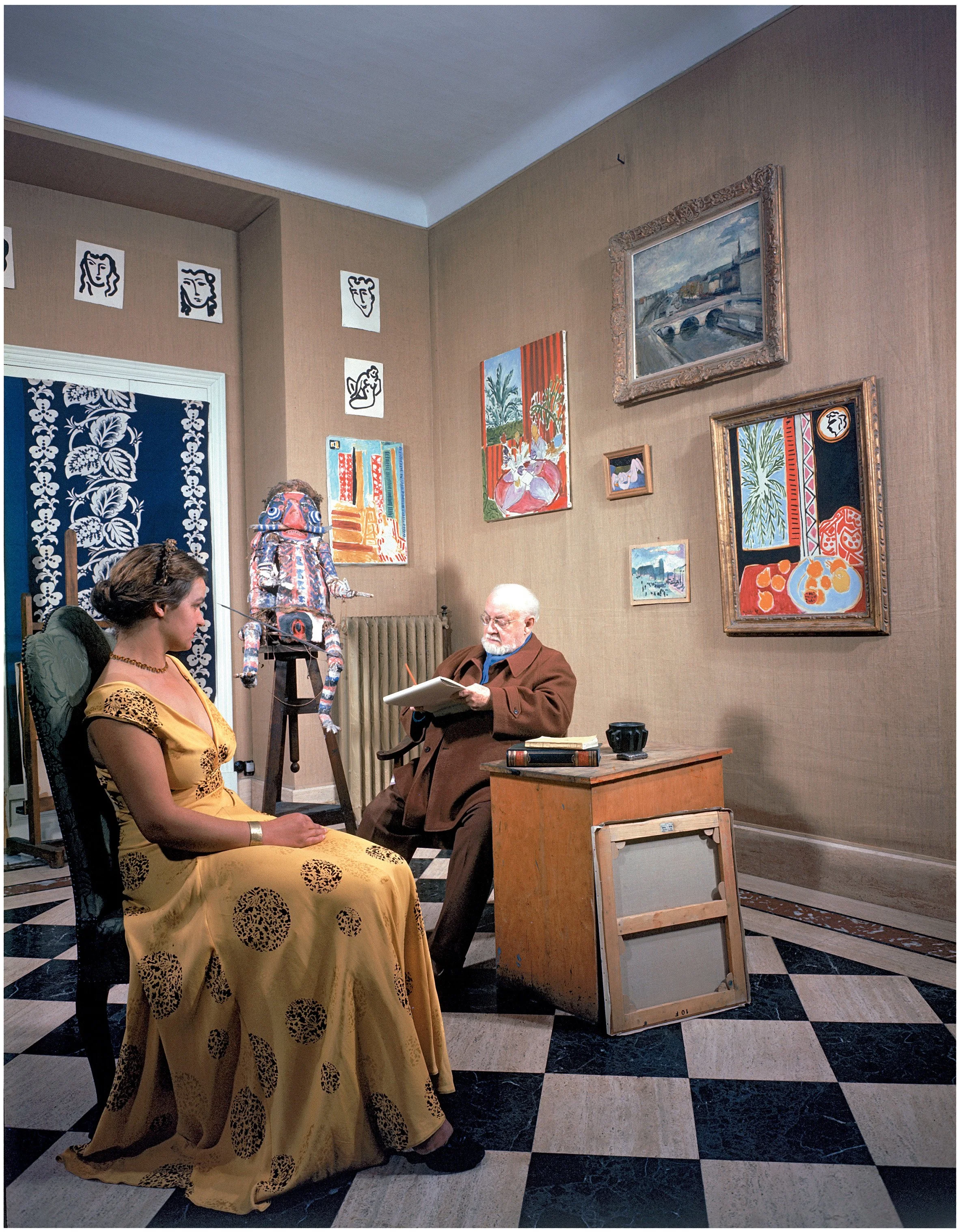
1_ Carmen Leschennes posing for Henri Matisse, Le Régina, Nice, summer 1951, Photograph by Dmitri Kessel © Dmitri Kessel/The LIFE Picture Collection
Matisse's lifelong fascination with fabrics began long before the canvases that made him famous. Growing up in northern France, a region shaped by a rich textile tradition, he developed an early sensitivity to woven surfaces, embroidery and ornamental patterns. Throughout his career he collected fabrics from his travels, oriental carpets, embroidered garments and printed cottons, building what he himself described as a "working library." These objects were never passive props. They became laboratories of vision.
Looking at Matisse's paintings through this lens means recognising that decoration was never secondary to his art. Pattern does not merely occupy the background; it destabilises the distinction between figure and ground. Wallpaper, carpets, dresses and screens flatten perspective while simultaneously expanding pictorial space. Colour ceases to imitate reality and begins to construct it.
Many years later, Yves Saint Laurent would approach textiles with remarkably similar intentions.
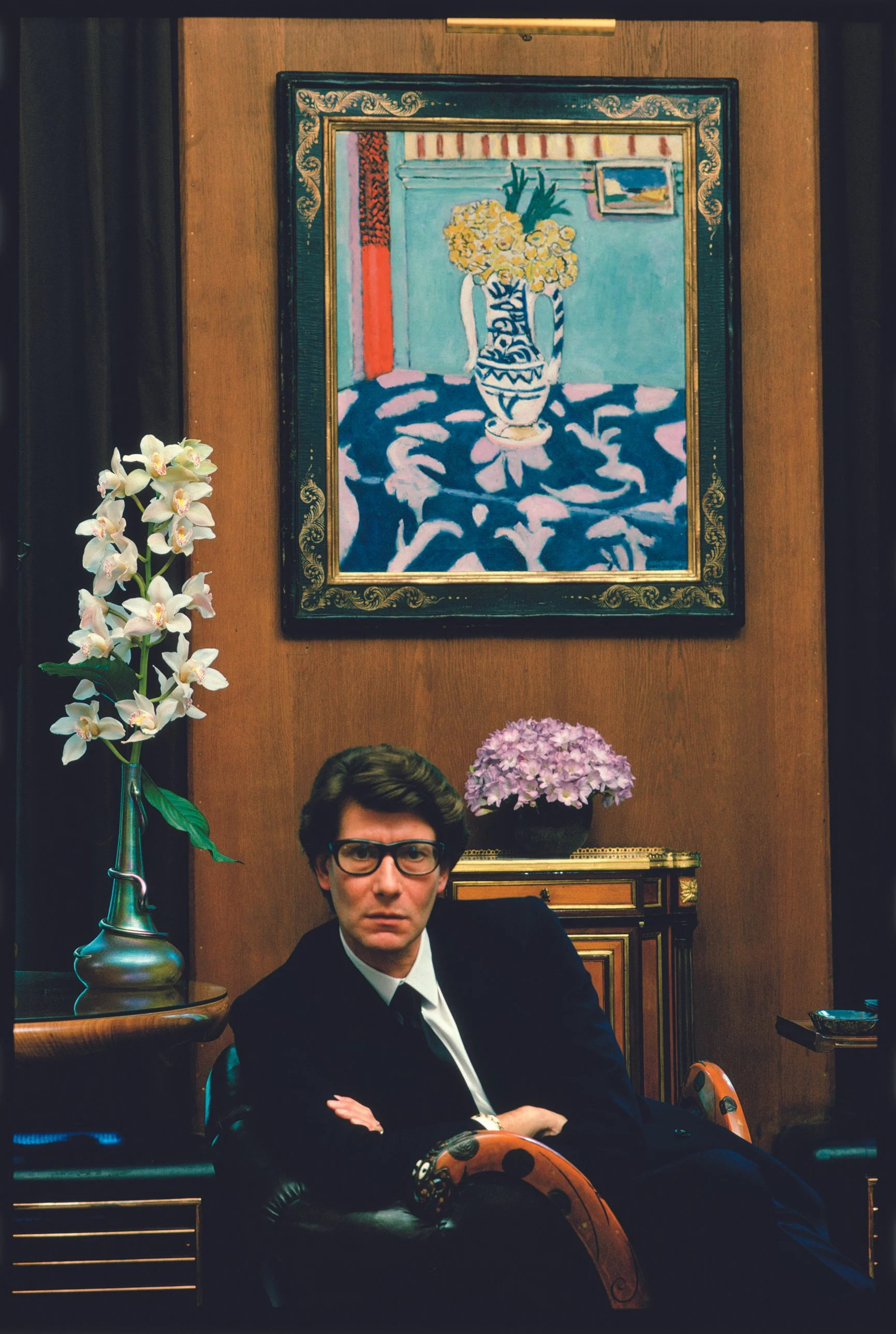
Yves Saint Laurent with Matisse’s painting, The Cowslips, Blue and Pink Carpet [Les Coucous, tapis bleu et rose] in his apartment 55 rue de Babylone, Paris, 1983 © Photo : Duane Michals, Courtesy of DC Moore Gallery, New York
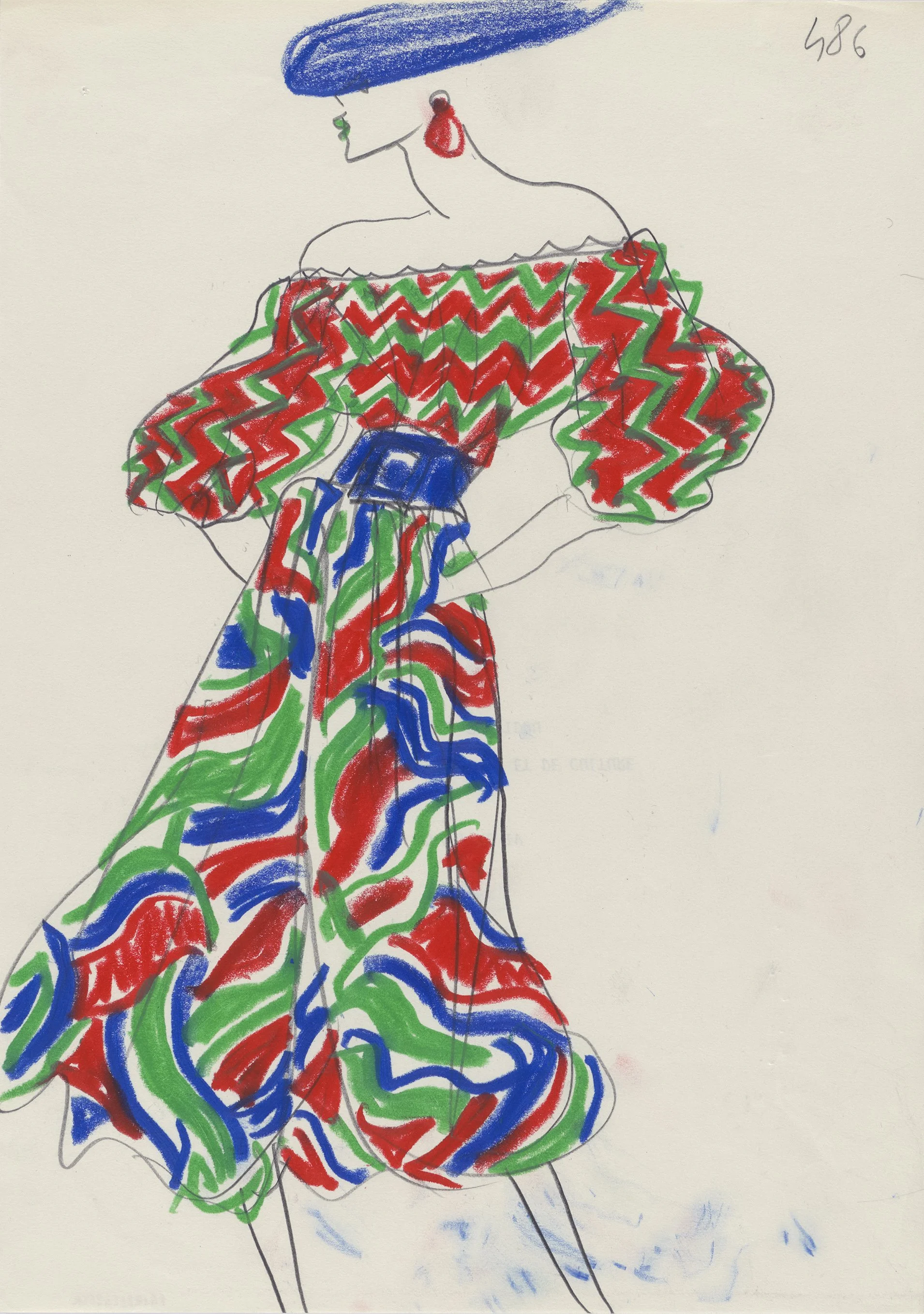
Yves Saint Laurent, original sketch of an evening outfit, SAINT LAURENT rive gauche spring-summer 1988 collection, Pastel and graphite pencil on paper, 29.6 × 21 cm, Musée Yves Saint Laurent Paris © Yves Saint Laurent © Fondation Pierre Bergé–Yves Saint Laurent
His extraordinary collection of paintings, books and objects, assembled with Pierre Bergé, functioned much like Matisse's own visual archive: not as a display of taste but as an inexhaustible reservoir of ideas. For Saint Laurent, fabrics were never neutral materials waiting to become garments. They were already compositions of colour, rhythm and structure.
Seen from this perspective, fashion appears not as an applied art borrowing from painting but as another way of thinking through colour.
The exhibition makes this dialogue tangible in one of its strongest juxtapositions: Matisse's The blue dress reflected in a mirror and Saint Laurent's evening dresses inspired by its extraordinary silhouette and chromatic balance. It would be tempting to describe these garments as reinterpretations of a painting. That would be too simple.
What fascinated Saint Laurent was not the dress represented in the painting, but the way Matisse allowed the dress to become painting. The folds of taffeta, the luminous blues, the relationship between the figure and its surroundings—nothing functions as ornament. The dress structures the composition. It generates space.
Saint Laurent understood this instinctively. When similar cuts, colours and graphic motifs reappear decades later in his collections, they do not quote Matisse. They continue his investigation.
The same logic unfolds throughout the exhibition.
The Romanian blouse that captivated Matisse for its embroidered geometry re-emerges in Saint Laurent's haute couture collections of 1981 and 1999. The painter's fascination with oriental interiors, arabesques and odalisques finds an unexpected counterpart in Saint Laurent's celebrated Ballets Russes collection, nourished by the couturier's own encounters with Morocco. Turbans, embroidered jackets, floral motifs and asymmetrical stars migrate from painting to fashion without ever losing their autonomy.
What travels is not imagery; it is a way of seeing. Perhaps nowhere is this continuity more evident than in the final section dedicated to Matisse's cut-outs.
Created late in life, when illness prevented him from painting in conventional ways, the gouaches découpées represented a radical reinvention of artistic practice. Colour was no longer contained within drawing; colour itself became drawing. Scissors replaced the brush. Paper became movement. Forms seemed to float freely across walls, liberated from the traditional limits of the canvas.
Saint Laurent immediately recognised the revolutionary nature of this gesture.
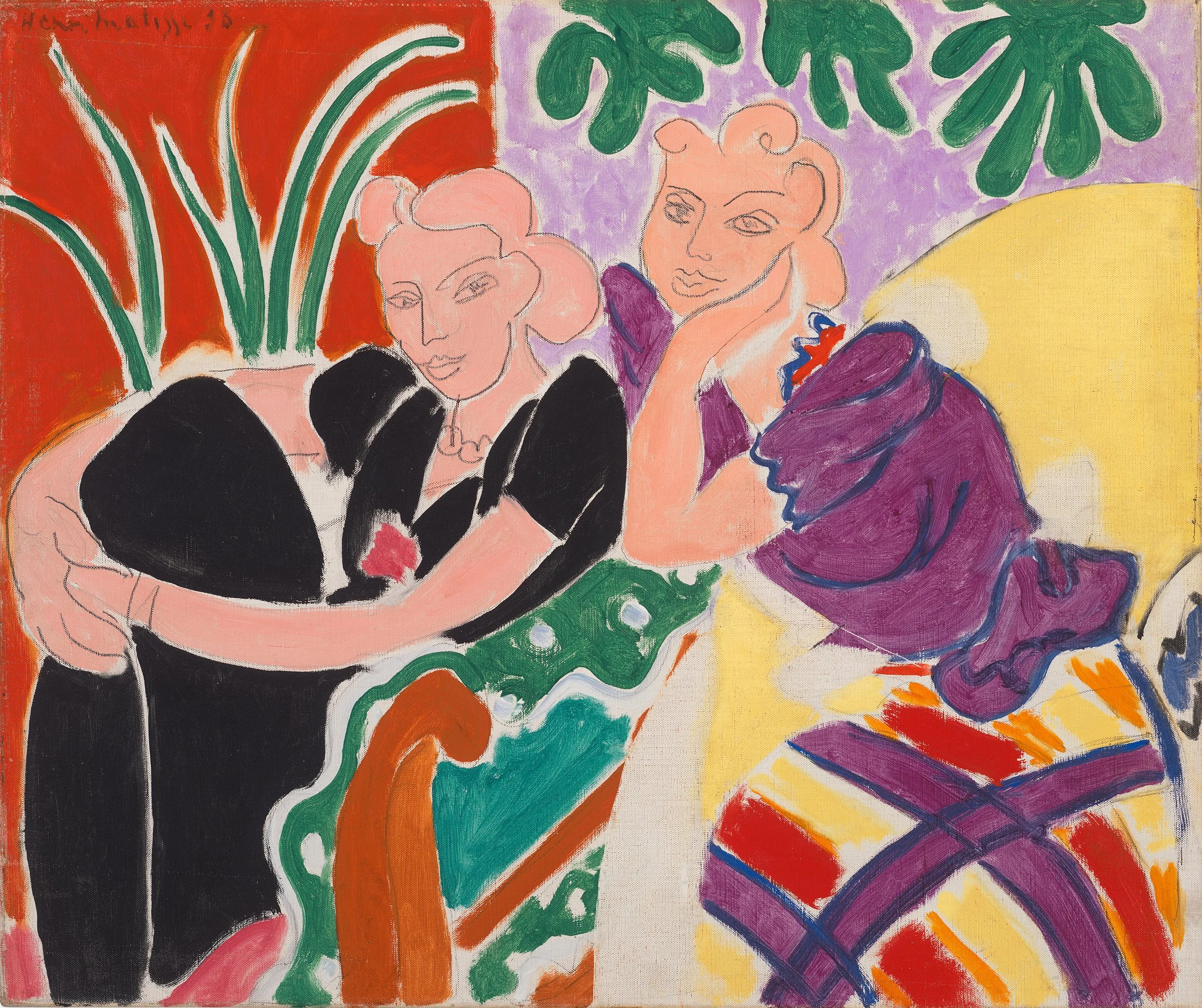
Henri Matisse, The Conversation [La Conversation], 1938, Oil on canvas, 46.7 × 55.4 cm, San Francisco Museum of Modern Art, Bequest of Mr. James D. Zellerbach © Photo : San Francisco Museum of Modern Art/Bridgeman Images
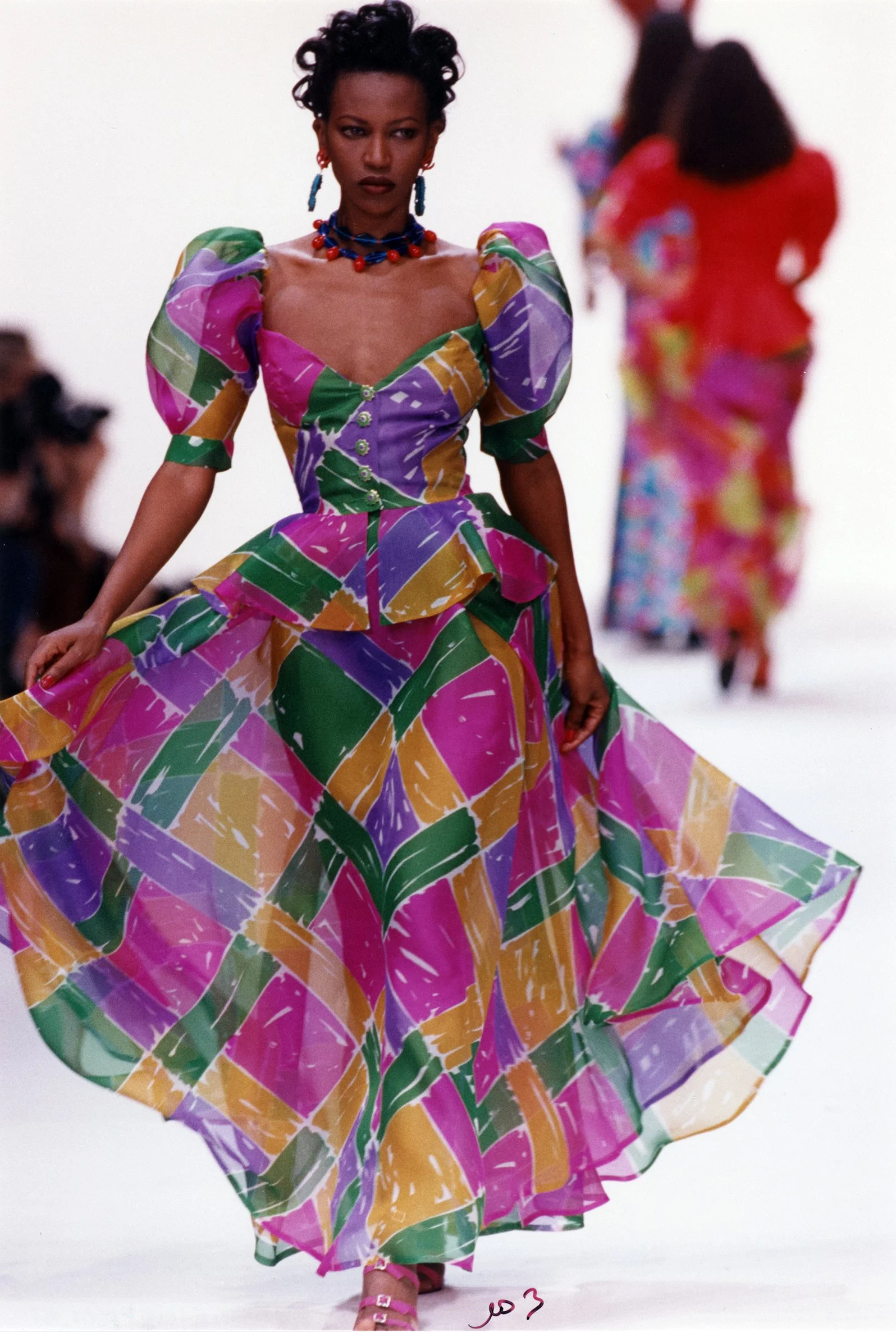
Yves Saint Laurent, evening outfit worn by Amalia Vairelli. SAINT LAURENT rive gauche spring-summer 1994 collection. Cour du Louvre, Paris, October 1993, Musée Yves Saint Laurent Paris, Photo © Guy Marineau
He translated Matisse's cut-outs into textiles, evening dresses and accessories, but more importantly he understood their underlying principle. Fashion was no longer simply dressing the body. It became a choreography of colour.
The garments did not wear paintings; they allowed paintings to continue moving. This is perhaps the exhibition's greatest achievement, and it quietly dismantles one of the most persistent hierarchies in Western culture: the distinction between fine art and the decorative arts.
For centuries, decoration has often been treated as something secondary—a supplement to more serious artistic concerns. Matisse challenged that hierarchy by making ornament one of the foundations of modern painting. Saint Laurent extended that challenge into fashion, demonstrating that embroidery, pattern and textile design could become sophisticated vehicles of artistic thought rather than mere embellishment.
Decoration, in both cases, is not the opposite of intelligence. It is one of its highest forms.
There is another reason why this exhibition feels unexpectedly timely.
We live in a cultural moment in which beauty has become strangely difficult to discuss. It is often dismissed as superficial, confused with luxury, or reduced to the language of consumption and branding. Within contemporary critical discourse, beauty can appear almost suspect—too seductive to be intellectually serious, too pleasurable to be politically meaningful.
Yet the dialogue between Matisse and Saint Laurent suggests another possibility.
For neither artist was beauty an escape from reality or an aesthetic luxury reserved for the privileged. Beauty was a discipline of perception. Colour was never applied simply to make things attractive; it became the force that organised space, shaped emotion and transformed the experience of looking. Likewise, decoration was never ornamental excess but a language capable of revealing new relationships between body, environment and imagination.
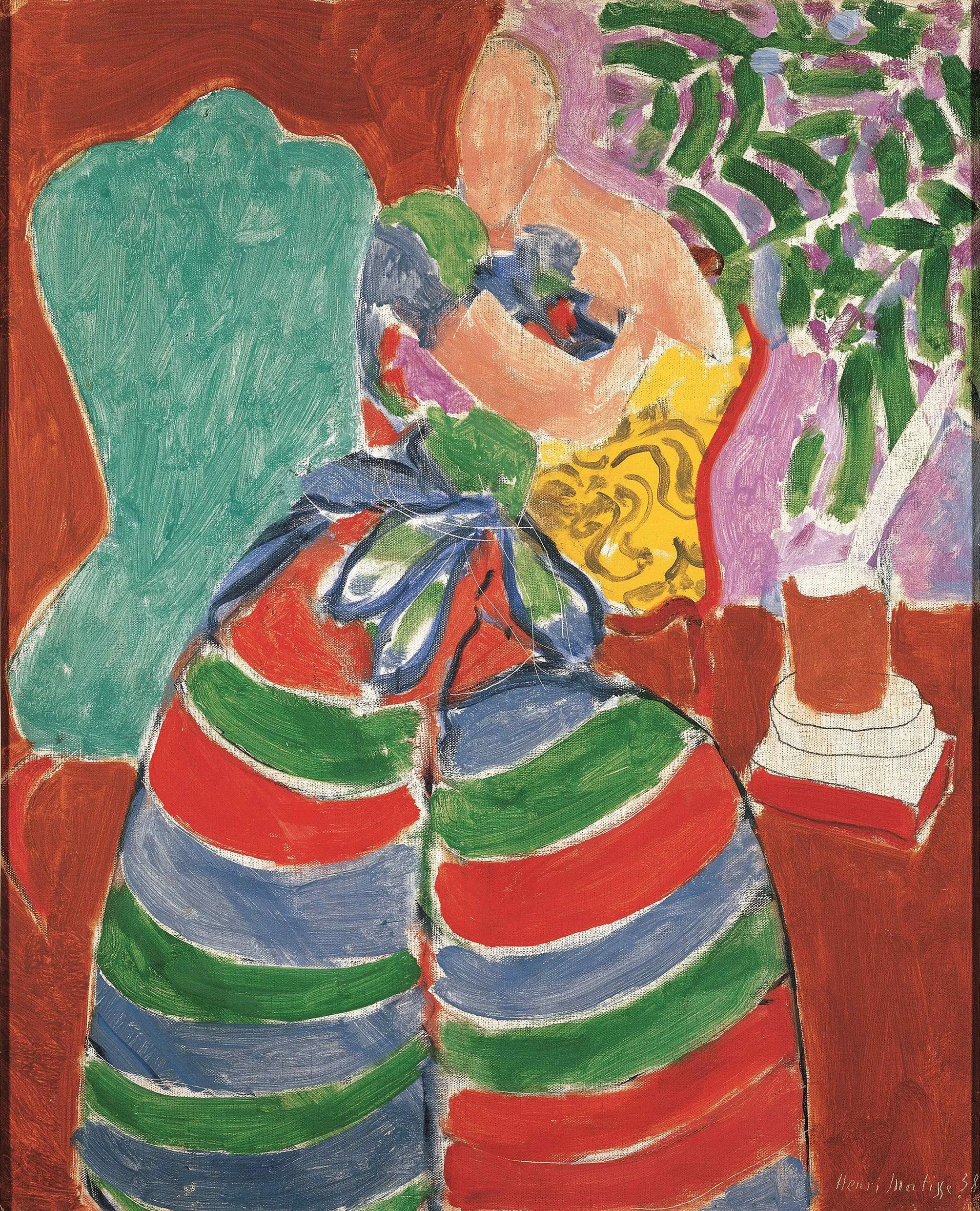
Henri Matisse, The Striped Dress [La Robe rayée], 1938, Oil on canvas, 46 × 38 cm, Albertina, Vienna – Batliner Collection © Photo: The Albertina, Vienna
In this sense, Le Beau, la Mode et le Bonheur is not simply an exhibition about painting and fashion. It is an argument for the rehabilitation of beauty itself—not beauty understood as perfection or luxury, but as a form of attention. A way of looking more carefully. A way of slowing perception in order to experience the world more intensely.
At a time when visual culture is increasingly consumed at speed and images are produced to be instantly replaced by the next, Matisse and Saint Laurent remind us that beauty still possesses a radical potential. Not because it distracts us from reality, but because it asks us to remain with it a little longer.
In the end, Yves Saint Laurent did not simply translate Matisse into fashion. He continued one of the painter's deepest investigations: how colour can leave the canvas and enter life itself.
Fashion, here, is not wearable art. It is painting that has learned to move.